Cometarium
日本語マニュアル
Cometarium は、彗星がいつ・どこに見え、どんな尾を引くのかを描く天文アプリです。 背景の星は実際の星表(Bright Star Catalogue、6.5 等まで)、彗星の位置は NASA/JPL の 軌道解を出発点にした N 体積分の結果で、尾は太陽光の輻射圧と太陽風のモデルから 計算しています。通信するのは光度の「再計算」を押したときだけで、それ以外に必要な データはすべてアプリに入っています。
無料版に収録されているのは 10P/Tempel 2・220P/McNaught・169P/NEAT・ 3200 ファエトン(ふたご座流星群の母天体)の4天体です。観測地は都道府県のほか、 MPC の観測所コードから国内 142 台・海外 2546 台の天文台を選べます。
光度の「再計算」を押すと、その場で COBS から最新の観測を読み込み、H₀ と n を
当てはめ直します。3200 ファエトンだけは光度式が違います — 小惑星として登録されて
いる天体には彗星の M1/K1 が無いため、小惑星の標準式(IAU の H・G 法)
V = H + 5 log rΔ − 2.5 log Φ(α) で計算します。位相角 α の項があるのが彗星の
式との違いで、「詳細」の光度モデルの欄にもそう表示されます。
共通の操作
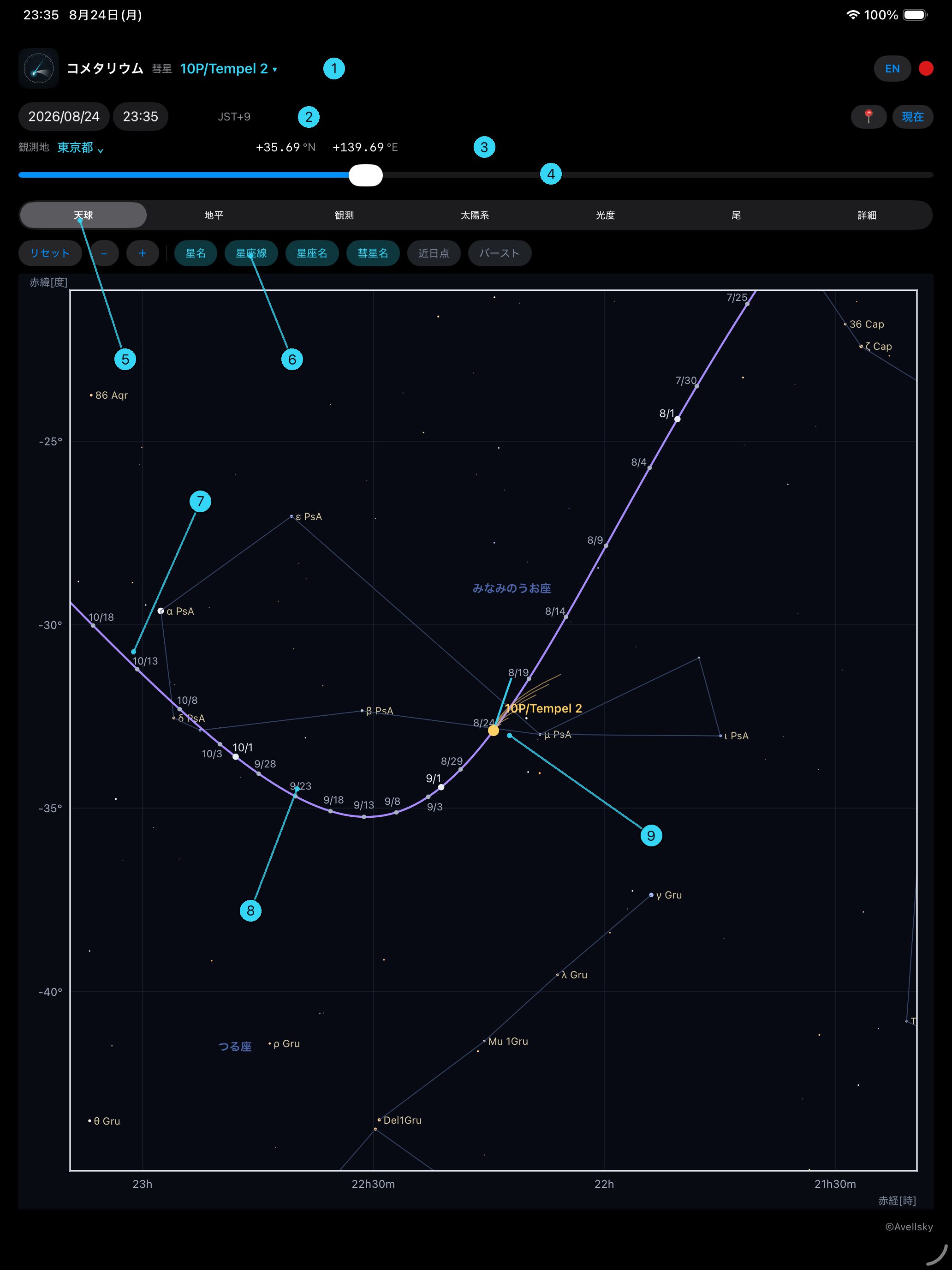
| 名称 | 説明 | |
|---|---|---|
| ① | アプリ名と対象天体 | いま表示している天体。10P/Tempel 2・220P/McNaught・169P/NEAT・3200 ファエトンから選べます。右端の EN で日英切替、赤い丸でナイトモード |
| ② | 日時と時刻系 | 日付・時刻(直接入力できます)と、それを読む時計(例: JST+9)。📍 で現在地を取得、現在で今日へ戻る |
| ③ | 観測地 | 都道府県または天文台(MPC 観測所コード)から選ぶか、緯度・経度を直接入力 |
| ④ | 日付スライダ | 収録期間を端から端まで |
| ⑤ | 表示切替 | 天球 / 地平 / 観測 / 太陽系 / 光度 / 尾 / 詳細 の7画面 |
| ⑥ | 表示レイヤー | リセット・縮小 − ・拡大 + と、各レイヤー(点灯=表示中)。画面ごとに中身が変わります |
| ⑦ | 天球経路 | 収録期間の彗星の通り道 |
| ⑧ | 日付目盛 | 経路上の日付。拡大するほど細かくなります |
| ⑨ | 現在位置と彗星名 | ④で指定した日時の彗星。ダスト尾とプラズマ尾つき |
図はどれも指で動かせます。ドラッグで移動、ピンチで拡大縮小、「リセット」で元に 戻ります。Mac では地平の視野を矢印キーでも動かせます。
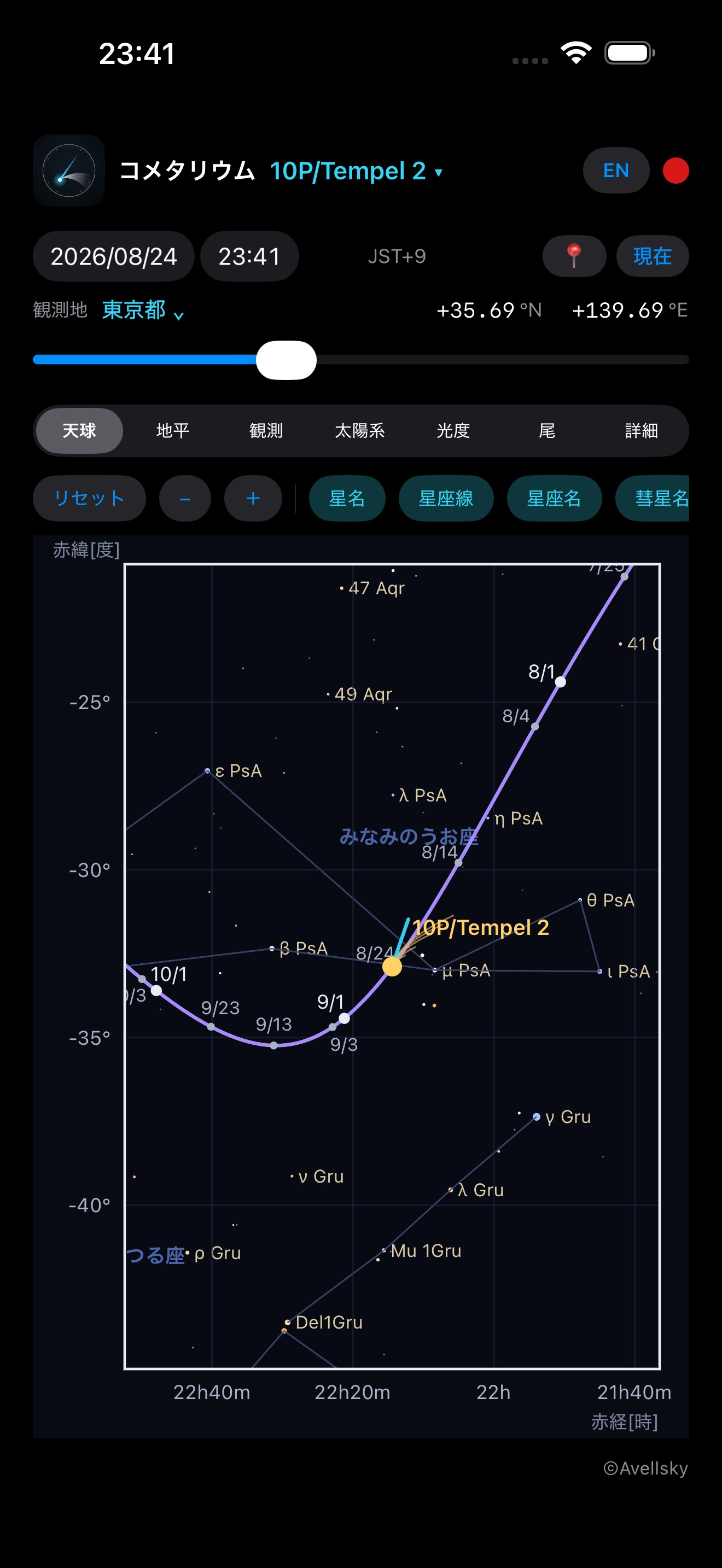
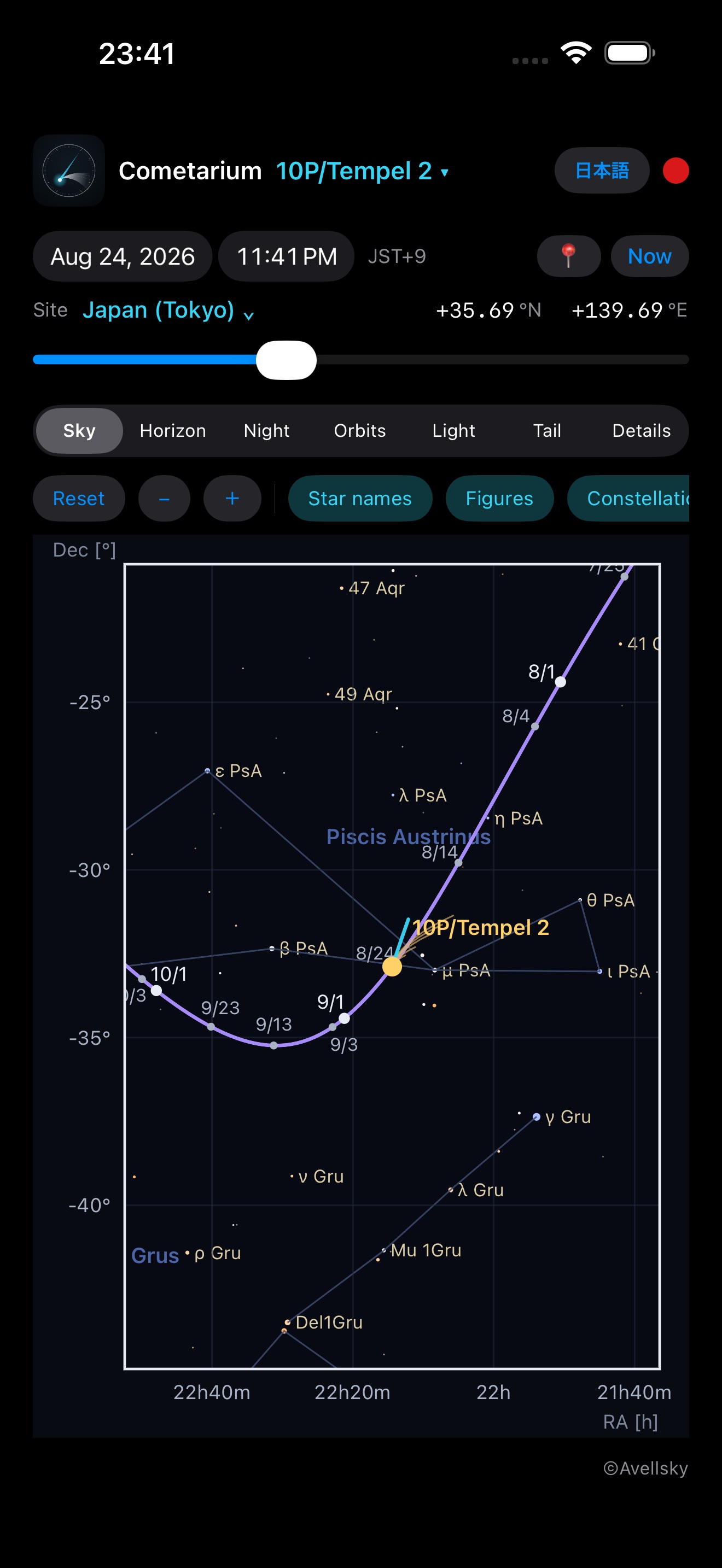
天球 — 星座の中の通り道
赤道座標(J2000.0)で、収録期間の経路を紫の線で描きます。横軸の赤経は 右へ行くほど小さくなります(西が右)。日付の目盛は「彗星が画面上でどれだけ速く 動くか」で決まるので、拡大すると月初だけだった目盛が半月ごと・10日ごとと自動的に 細分されます。星の色は B−V 色指数、大きさは実視等級です。
現在位置には尾が付きます。オレンジの扇がダスト尾(同じ大きさの塵が描く曲線= シンダイン)、水色がプラズマ尾で、いずれも「尾」パネルの設定がそのまま反映されます。
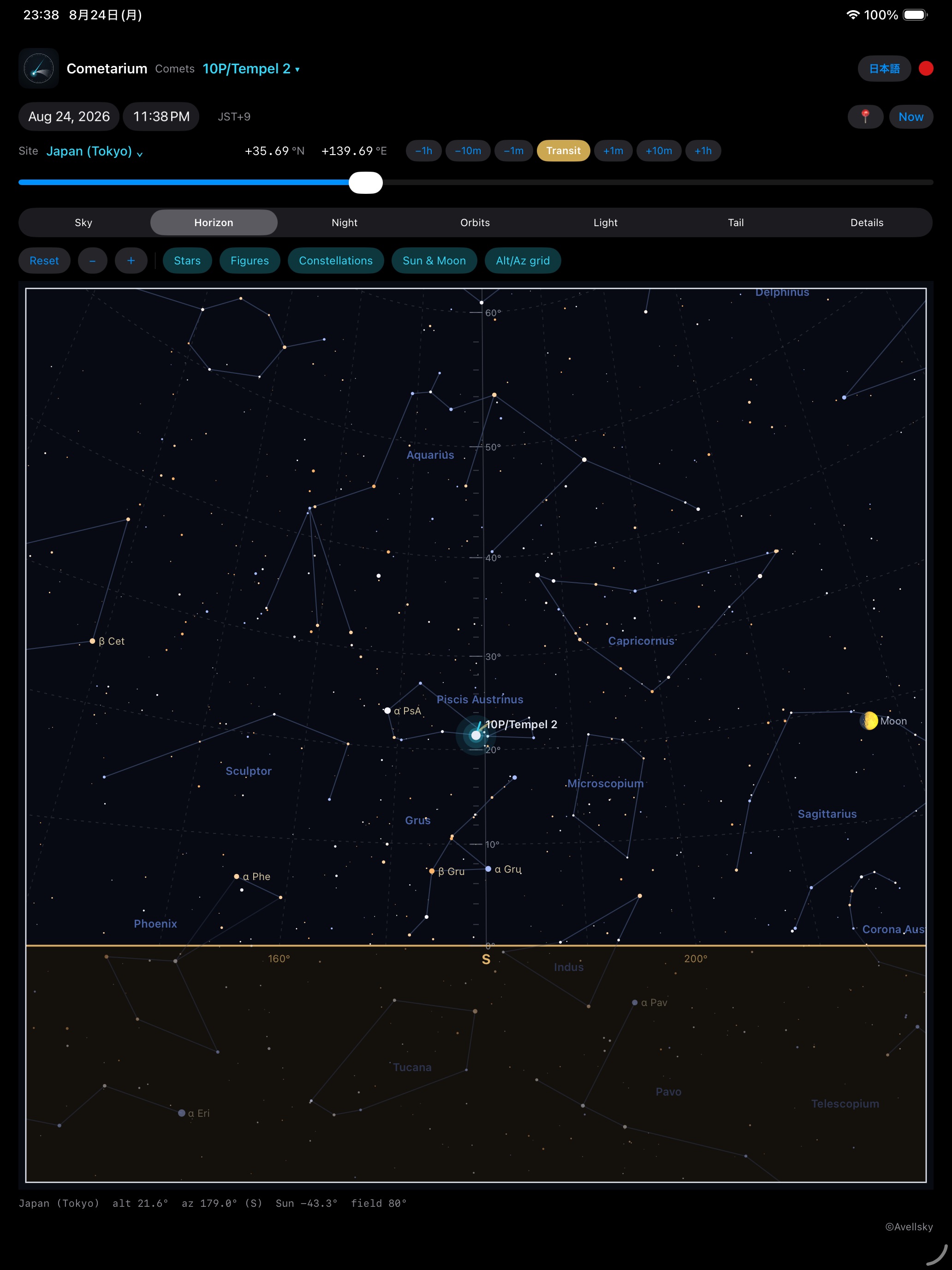
地平 — 実際に空を見上げた向き
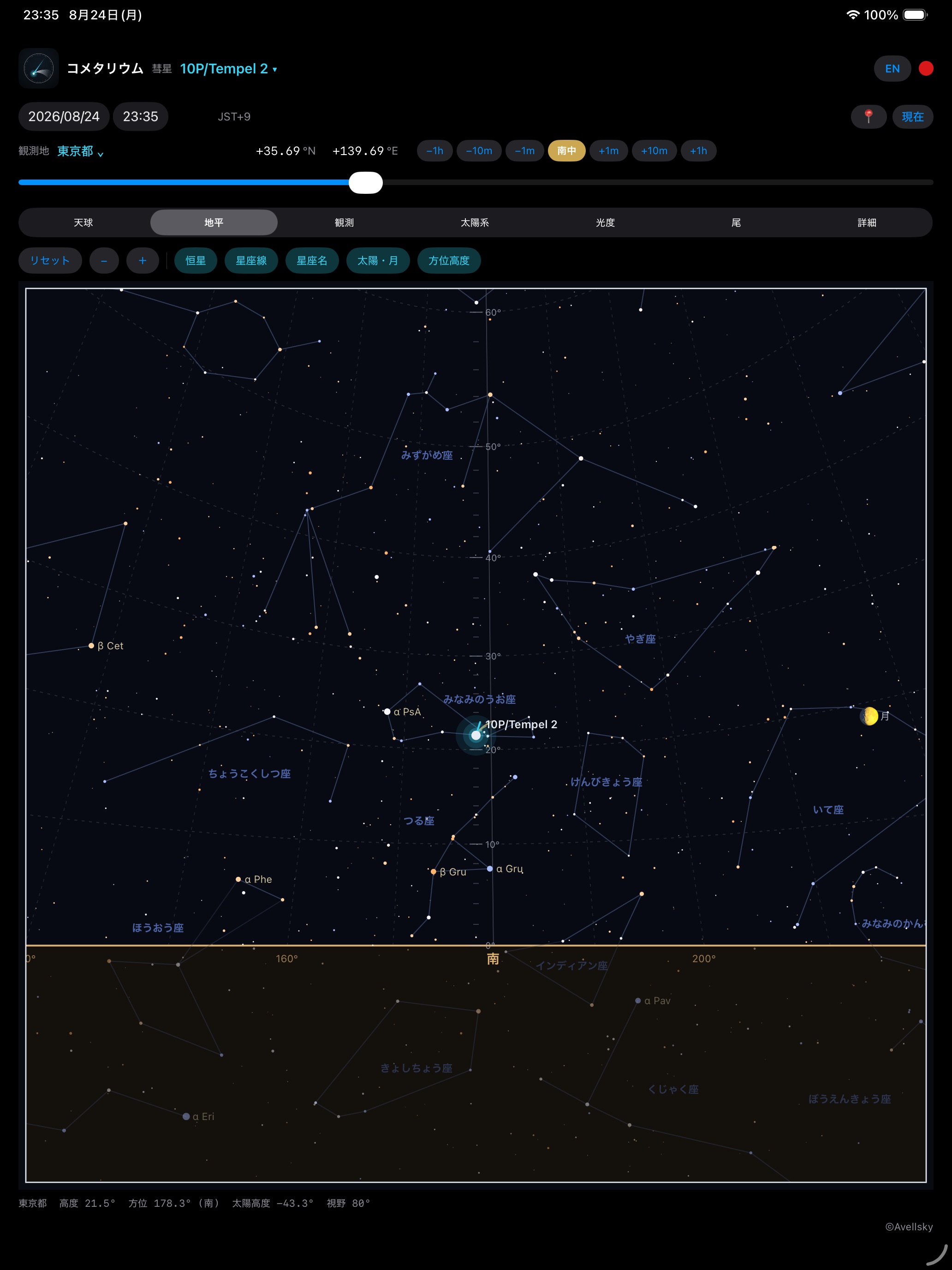
観測地の空を、彗星を中心に心射図法で描きます。空の色は太陽高度で変わり (昼の青 → 薄明 → 夜)、地平線と地面、方位(東西南北と度数)、高度の目盛が入ります。 方位は右へ行くほど増えます(北を向けば東が右、東を向けば南が右)。
- 目盛は視野に追従します。視野60°なら高度10°ごと(細目盛2°)、視野10°なら1°ごと
- 地平線下 20° までの星・太陽・月も薄く描くので、これから昇ってくる星が分かります
- 彗星が沈んでいるときは視点が地平線で止まり、「地平線の下」と表示されます
- 彗星名はドラッグで移動できます
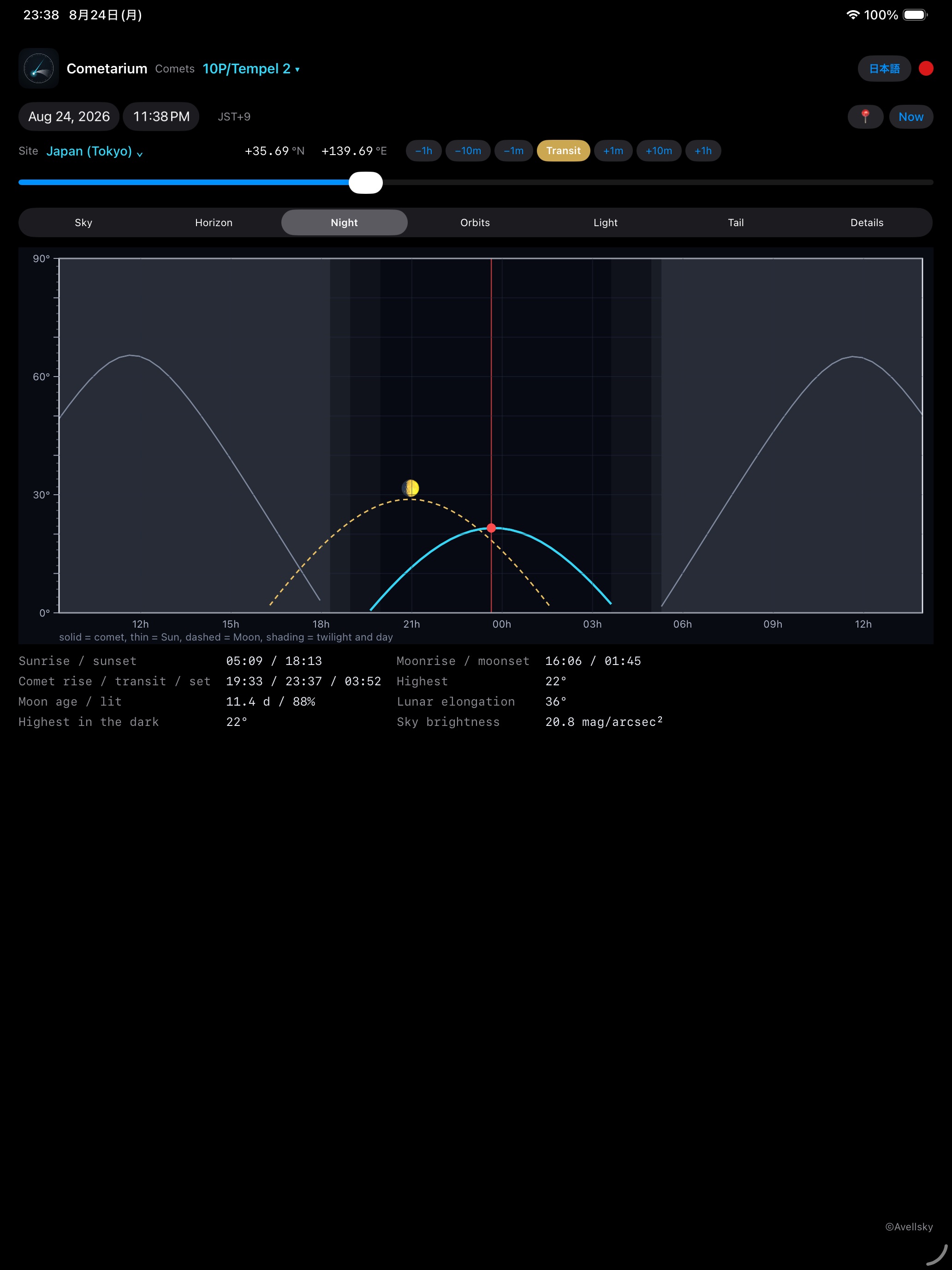
観測 — 一晩の高度と空の暗さ
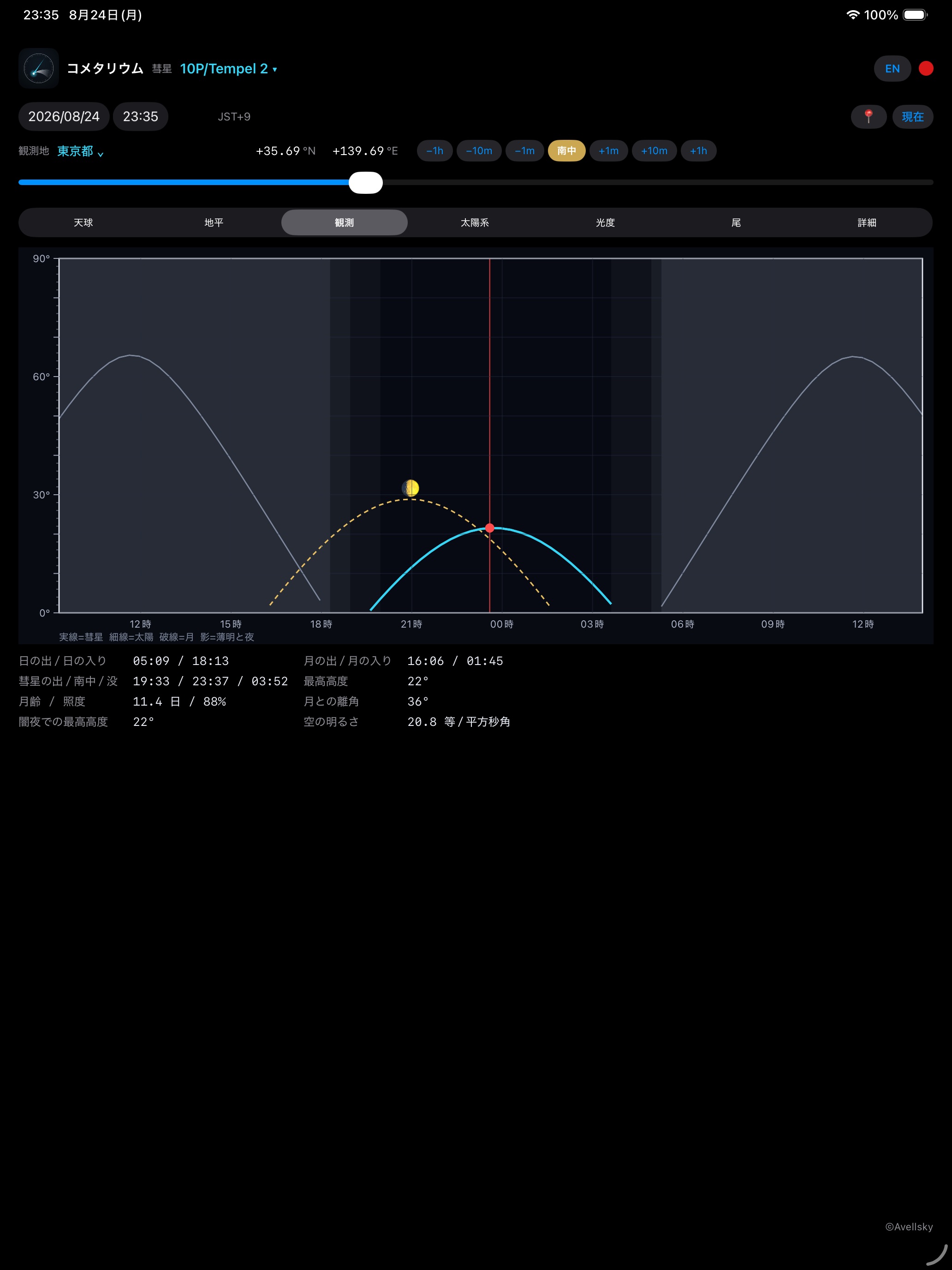
観測地の一晩について、彗星・太陽・月の高度を描きます。図の下に、日の出/入り、 月の出/入り、彗星の出・南中・没、最高高度、月齢と照度、月との離角、闇夜での最高高度、 空の明るさ(Krisciunas & Schaefer 1991 の式)が出ます。
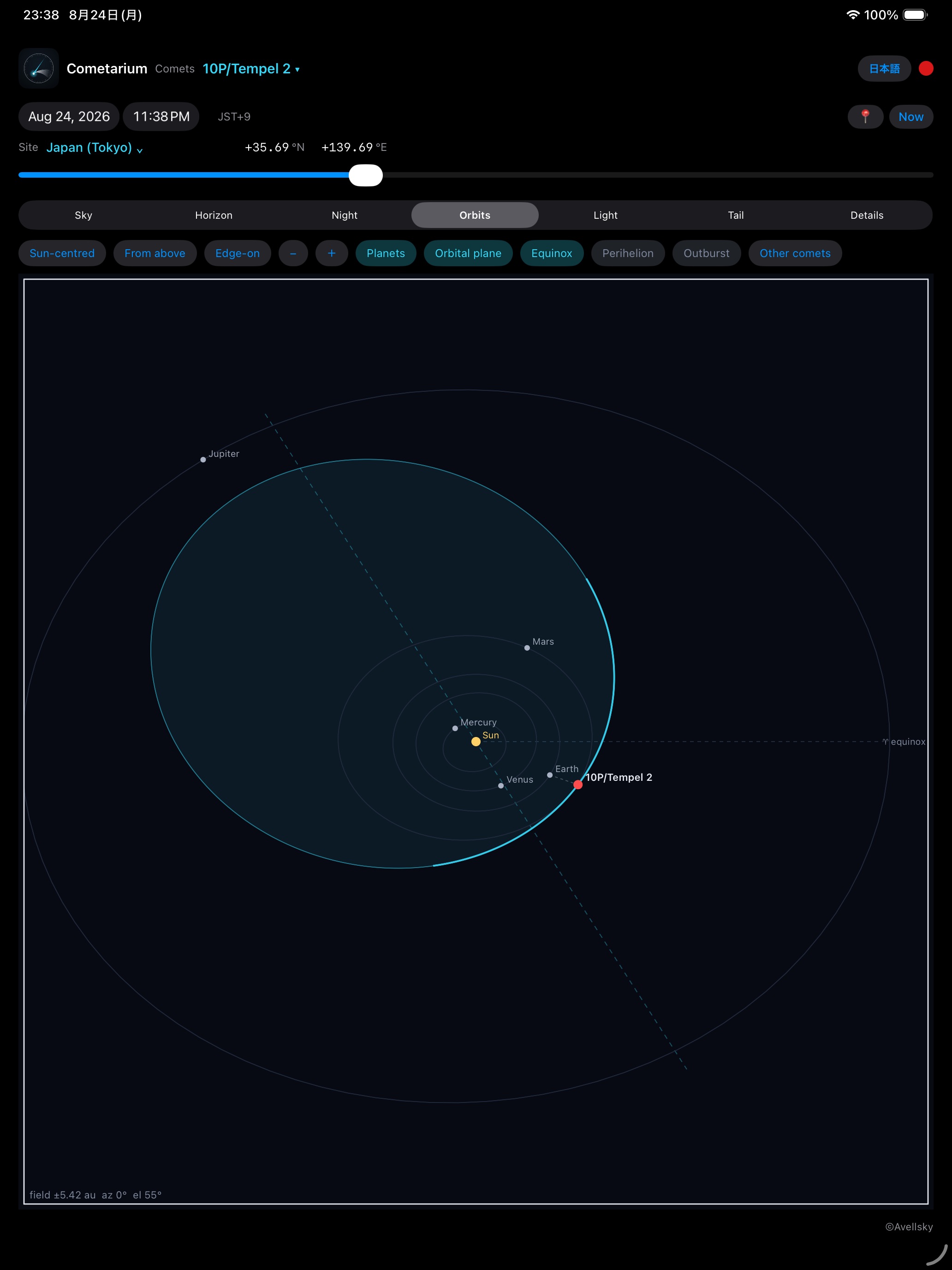
太陽系 — 軌道を上から、横から
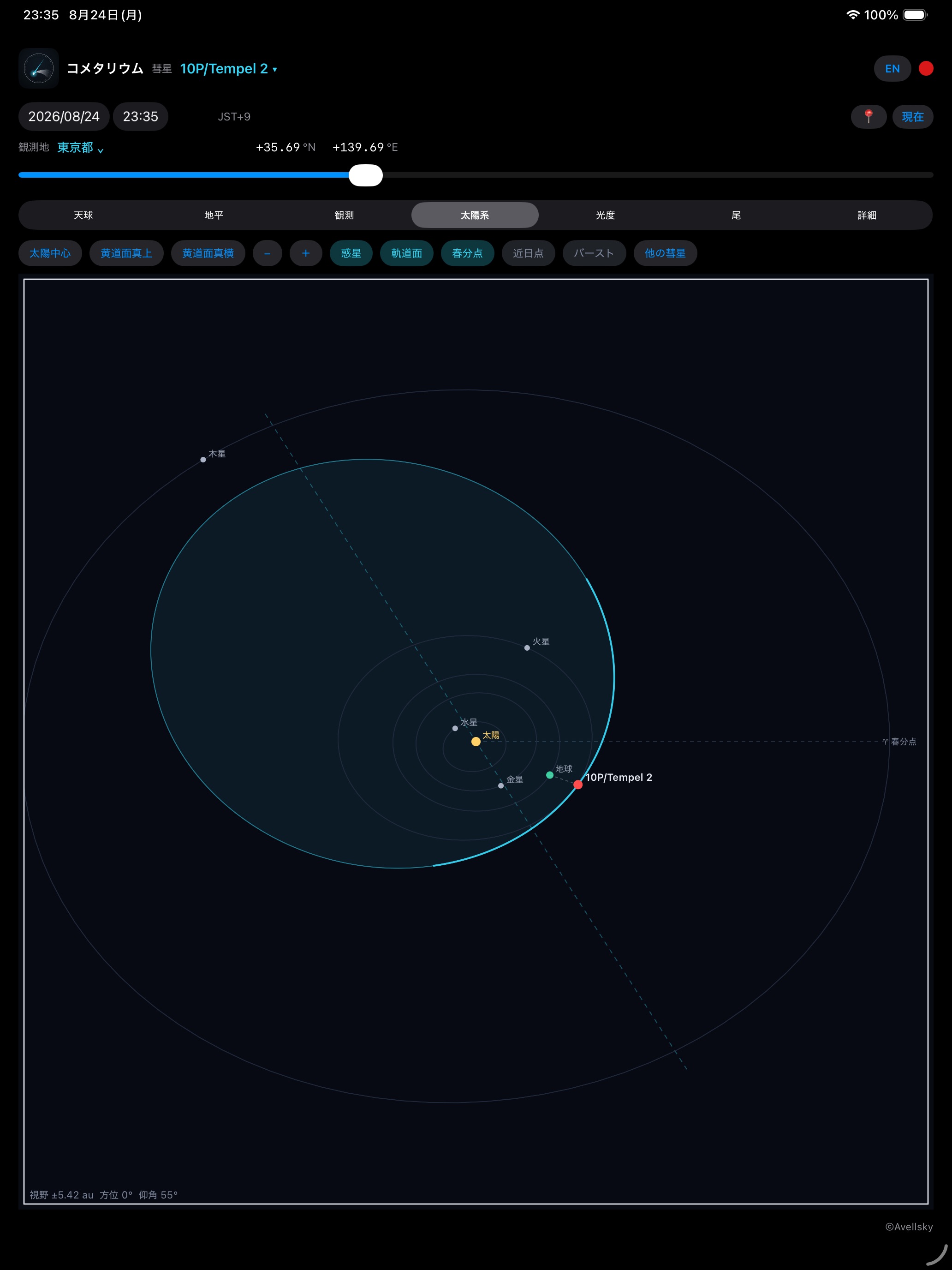
ドラッグで視点が回り、太陽中心・地球中心・彗星中心を切り替えられます。彗星の軌道は 全体を細く、収録期間を太く描きます。軌道面の塗り、春分点、近日点、バーストの表示は ボタンで切り替えます。「他の彗星」で 220P/McNaught の軌道を重ねて比べられます。
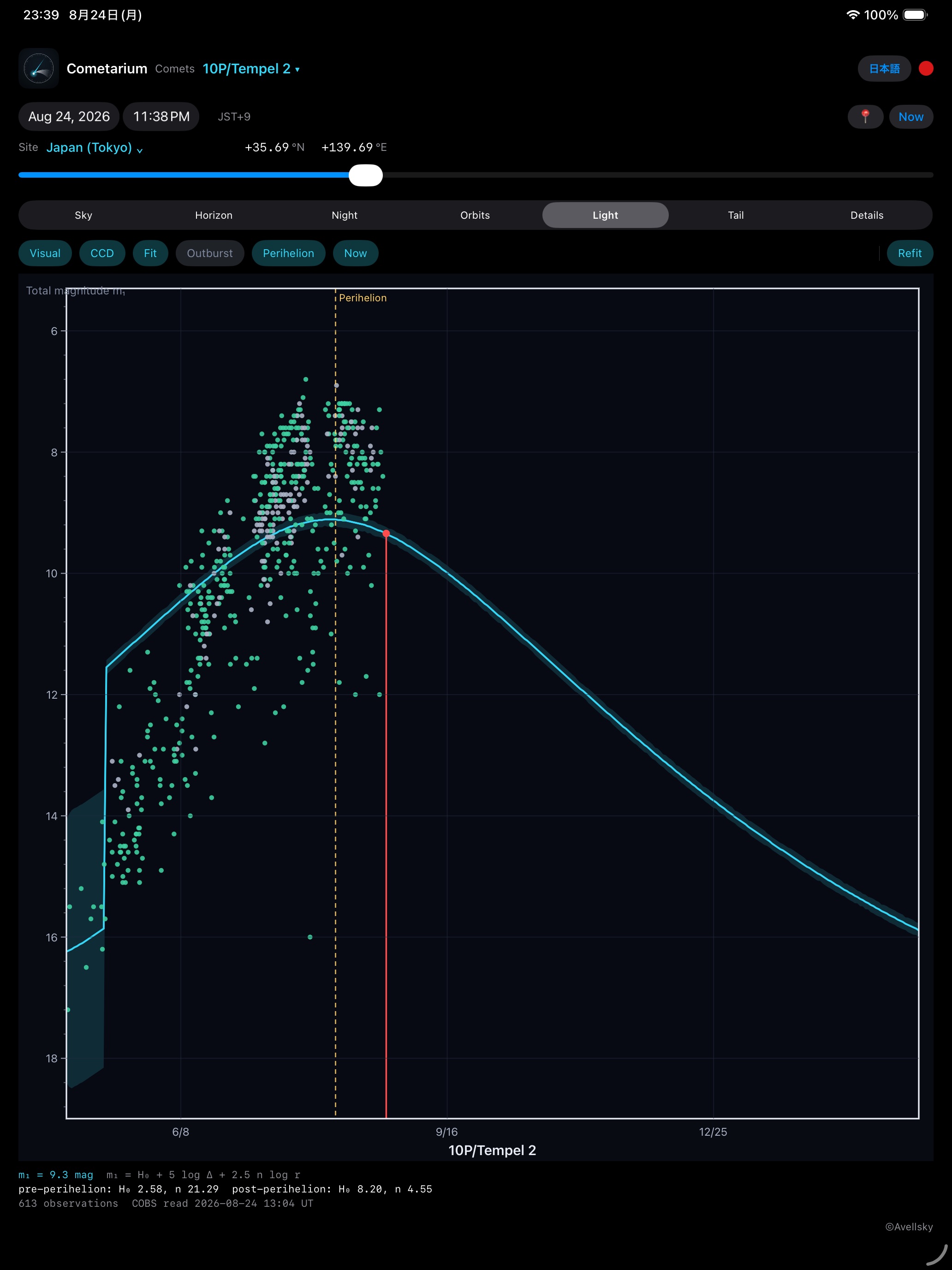
光度 — 明るさの実測と予測
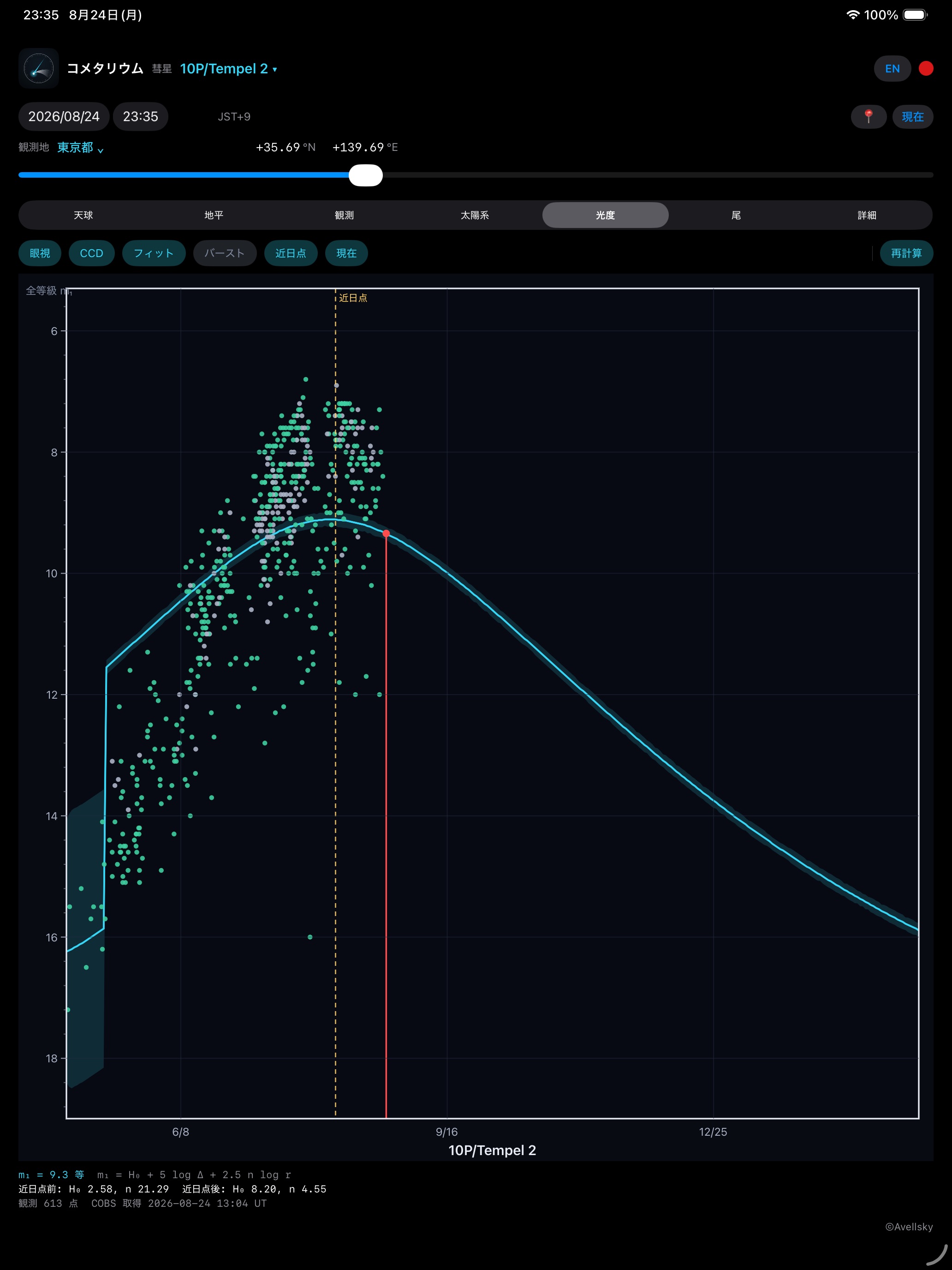
COBS の眼視(灰)と CCD(緑)の観測に、当てはめた光度式と ±3σ 帯を重ねます。図の下に
現在の予測等級 m₁、式 m₁ = H₀ + 5 log Δ + 2.5 n log r、近日点前後それぞれの
H₀ と n、観測数、COBS を読んだ日時が出ます。縦軸の刻みは等級の幅に合わせて自動で
細かくなります。
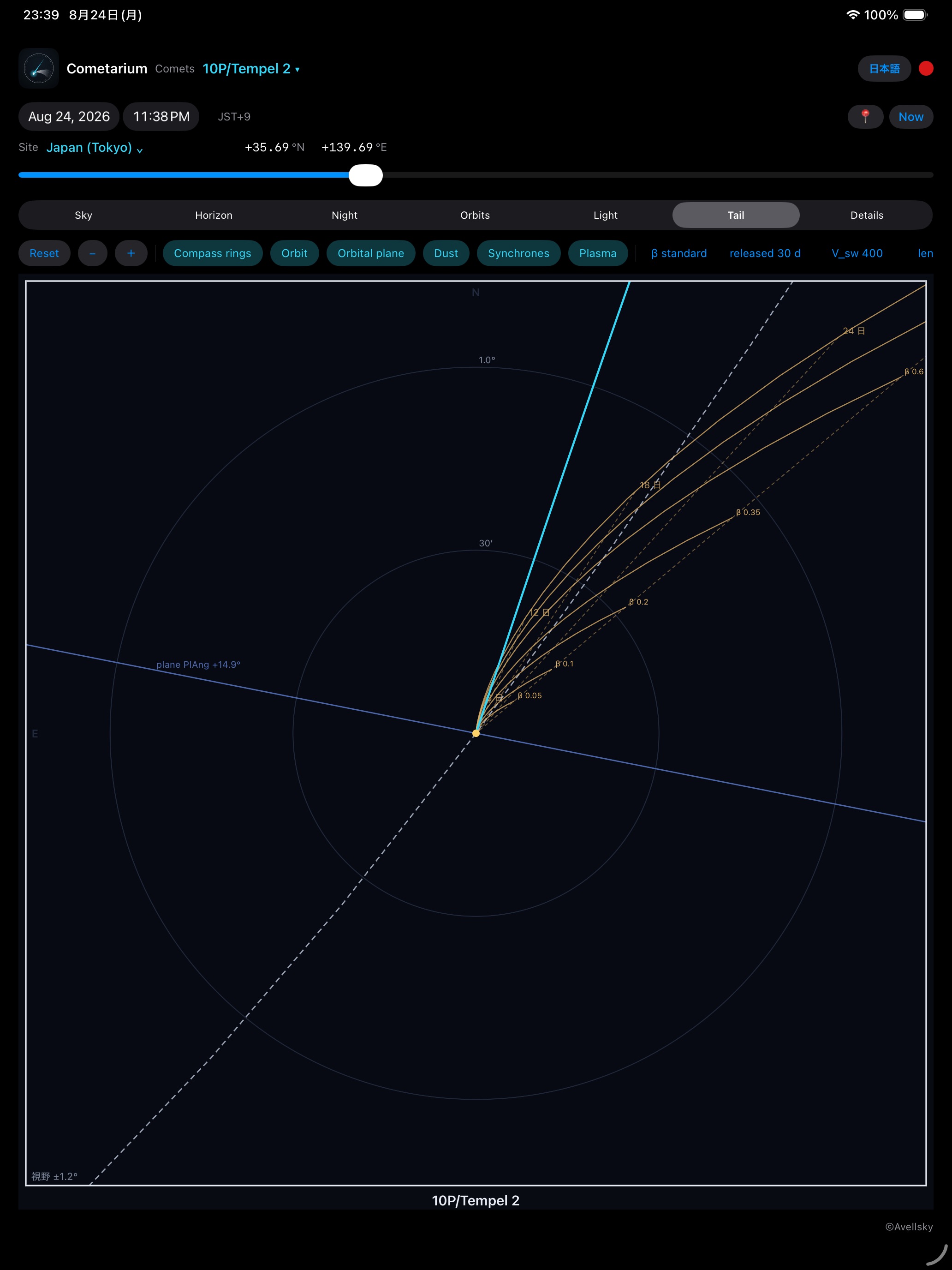
尾 — ダストとプラズマの形
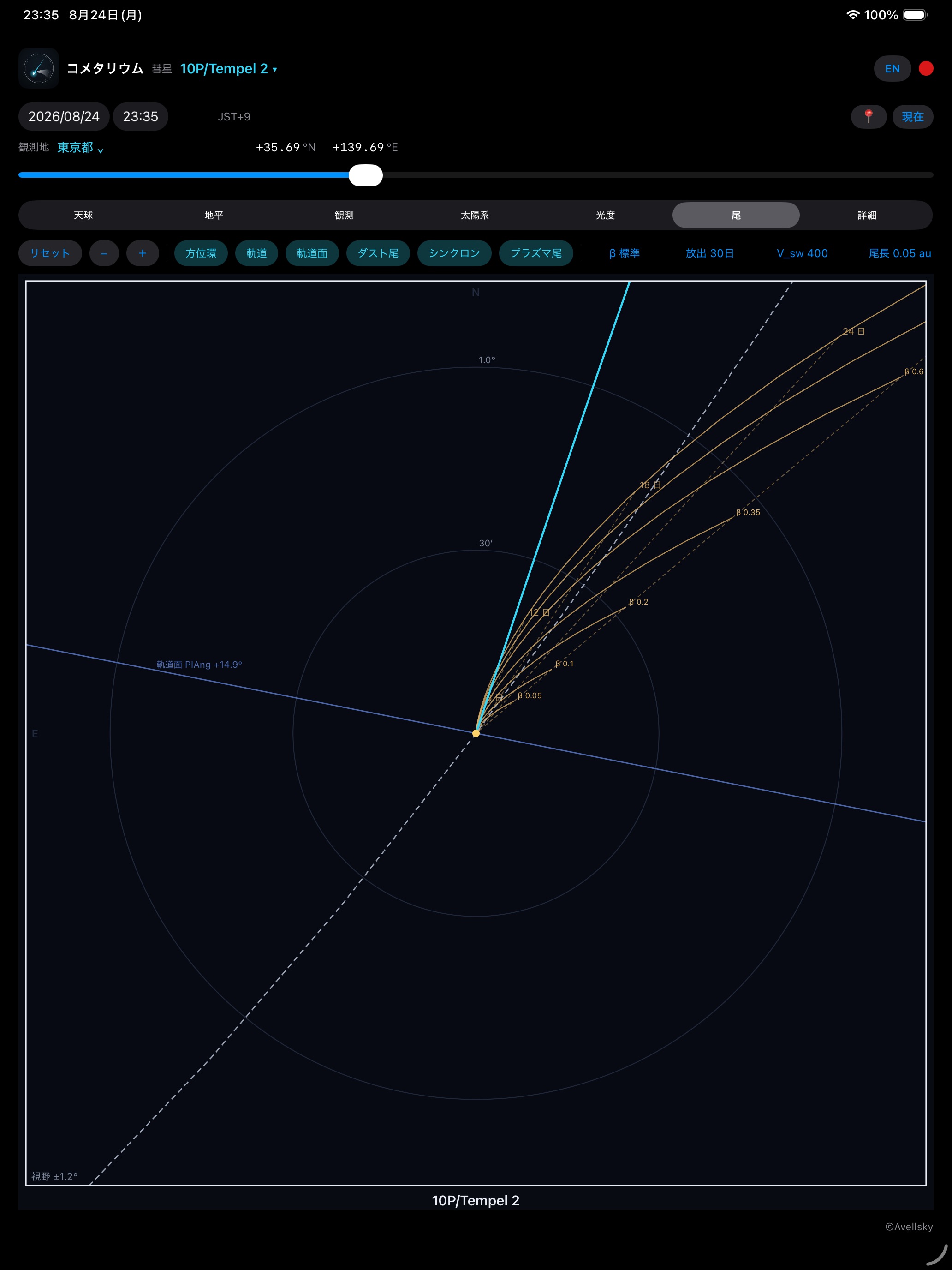
核を中心に、方位環(北が上、東が左)で尾の形を描きます。β(輻射圧と重力の比= 粒径)の粗さ、放出時刻(3〜90日前)、太陽風速度 V_sw、尾長を選ぶと、 その場で計算し直します。ここでの設定は天球と地平の尾にもそのまま反映されます。
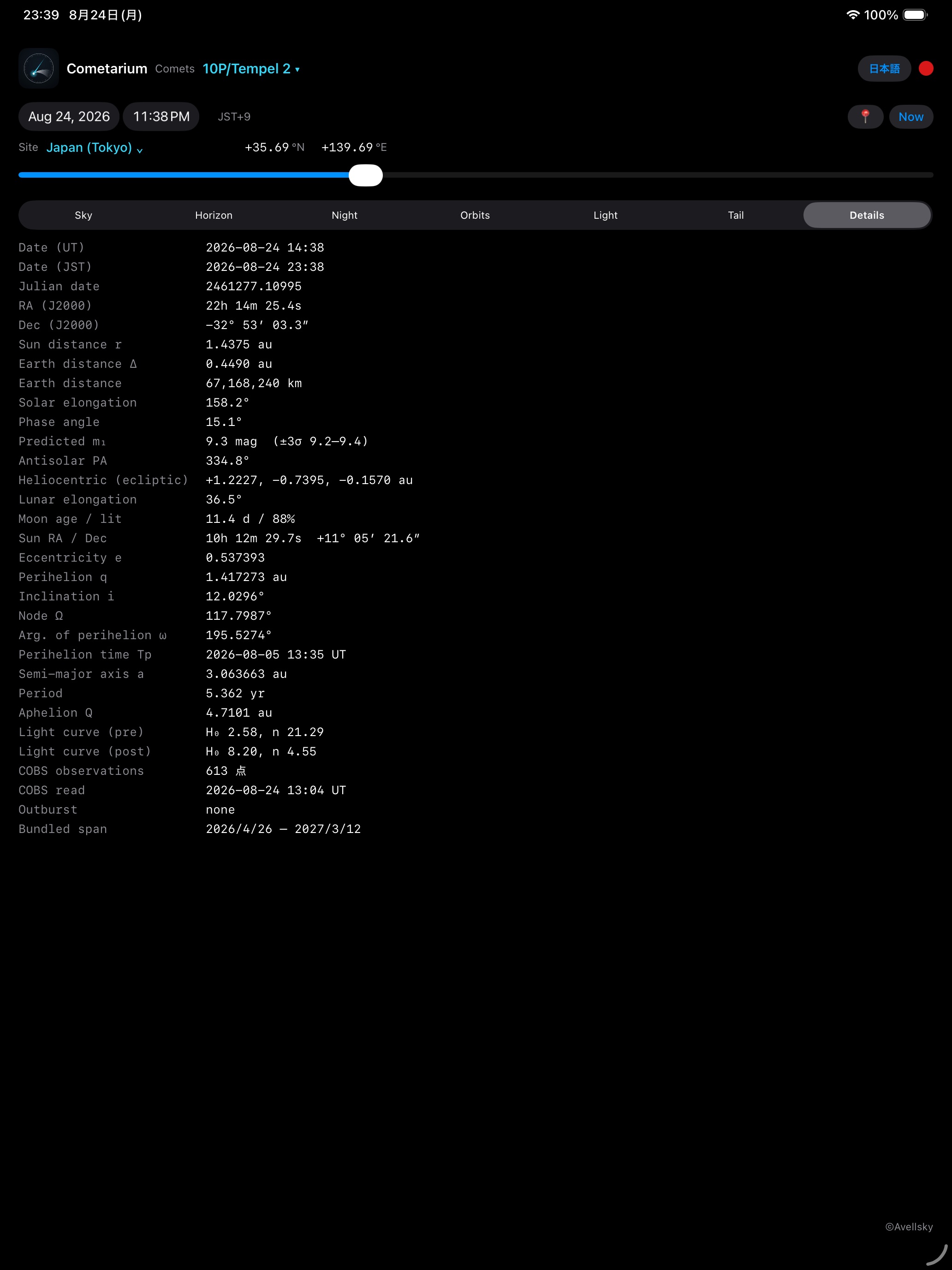
詳細 — その瞬間の数値
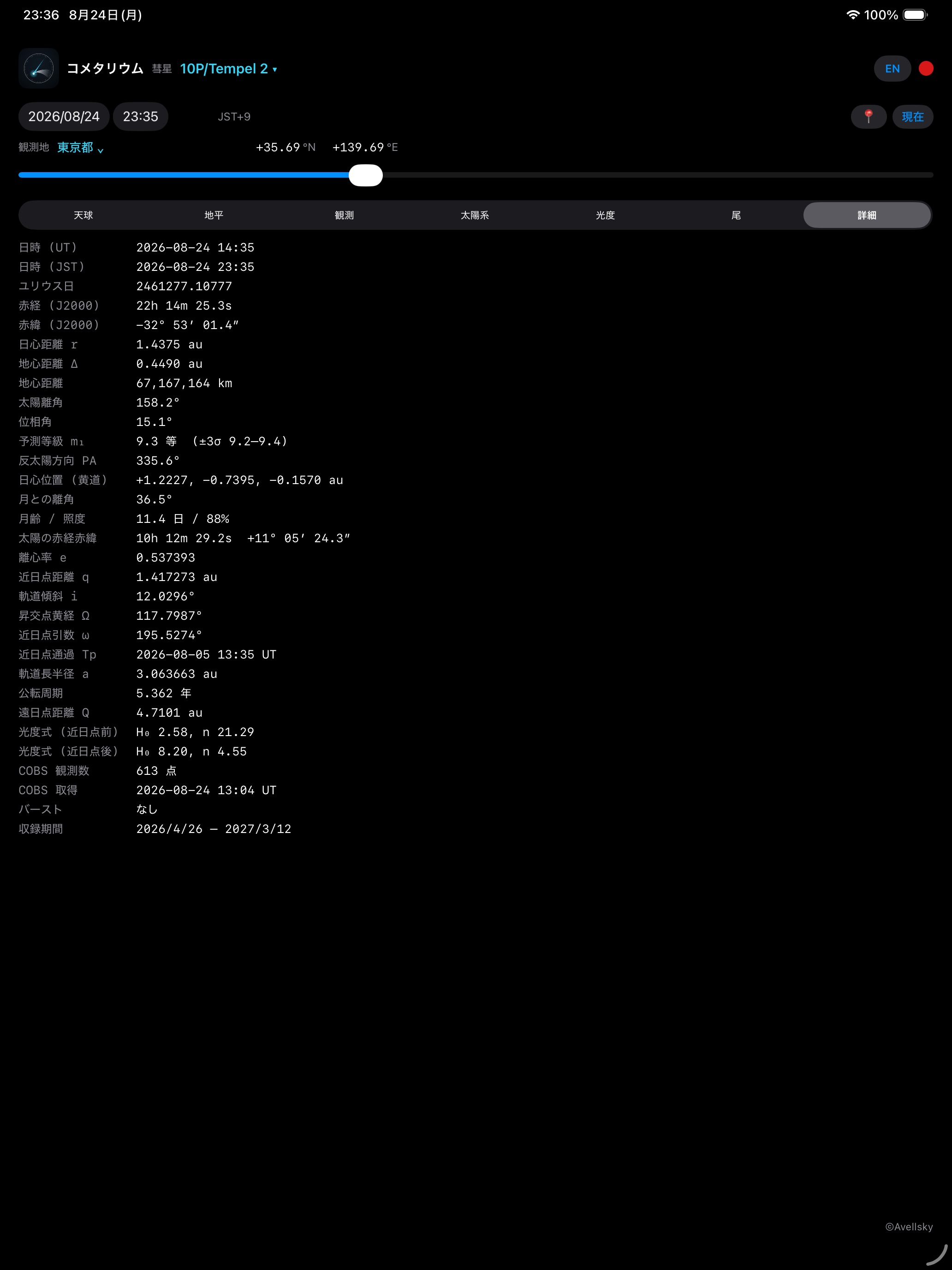
日時(UT/JST/ユリウス日)、赤経赤緯、日心距離 r、地心距離 Δ(au と km)、太陽離角、位相角、 予測等級 m₁(±3σ)、反太陽方向の位置角、日心位置、月との離角と月齢、太陽の位置、軌道6要素、 軌道長半径・公転周期・遠日点、光度式、COBS の観測数と取得日時、バーストの日付、収録期間。 距離と位置は光行時間を補正済みです。
iPhone での表示
収録内容
| 項目 | 内容 |
|---|---|
| 対象天体 | 10P/Tempel 2、220P/McNaught、169P/NEAT、3200 ファエトン |
| 画面 | 天球・地平・観測・太陽系・光度・尾・詳細 |
| 太陽系の比較軌道 | 収録した4天体を互いに |
| 観測地 | 都道府県 + MPC 観測所コード(国内 142 台 / 海外 2546 台) |
| 計算 | すべて端末内。通信は光度の「再計算」のときだけ |
計算とデータの出どころ
| 内容 | 出どころ |
|---|---|
| 軌道と天体暦 | NASA/JPL Horizons・SBDB・NAIF SPICE(DE440 / sb441) |
| 軌道の積分 | ASSIST(REBOUND 系)。惑星と主要小惑星の摂動、非重力加速度を含む |
| 光度と増光 | COBS(Comet Observation Database)の観測に基づく光度式の当てはめ |
| 星表・星座 | Bright Star Catalogue(V ≤ 6.5)、d3-celestial の星座線 |
| 太陽・月・惑星 | Meeus『Astronomical Algorithms』と Standish の近似要素(アプリ内で計算) |
| 尾の形状 | Finson–Probstein のシンダイン/シンクロン、Burns–Lamy–Soter の β、太陽風による吹き流し |
| 空の明るさ | Krisciunas & Schaefer 1991 (PASP 103, 1033) |
Credit: NASA/JPL-Caltech. Comet magnitude data courtesy of COBS Comet Observation Database.
よくある質問
Q. オフラインでも使えますか。 はい。位置計算も星図も光度曲線もアプリ内で完結します。通信するのは光度の「再計算」を押したときだけです。
Q. 位置情報は何に使いますか。 観測地の緯度経度を入れるためだけです。端末の外には出しません。
Q. ナイトモードとは。 画面全体を赤くして、暗順応を保ったまま読めるようにする表示です。
Q. どのくらい正確ですか。 位置は JPL の軌道解を出発点にした N 体積分で、実測とほぼ一致します。彗星の明るさは本質的に予測が難しく、実際の観測とずれることがあります。
Q. どの天体を扱えますか。 10P/Tempel 2・220P/McNaught・169P/NEAT・3200 ファエトンの4天体です。太陽系の画面では互いの軌道を並べて比べられます。
Q. ファエトンは彗星ではないのでは。 そのとおりで、小惑星として登録されています(ふたご座流星群の母天体)。そのため光度だけは小惑星の標準式(IAU の H・G 法)で計算しており、「詳細」にもそう記してあります。
English Manual
Cometarium shows where a comet is, when it can be seen and how its tails lie on
the sky. Background stars come from the Bright Star Catalogue (to V = 6.5), the
comet's position from an N-body integration started at the NASA/JPL orbit
solution, and the tails from radiation-pressure and solar-wind models.
The only thing that reaches the network is the light curve's Refit button.
It covers 10P/Tempel 2, 220P/McNaught, 169P/NEAT and
3200 Phaethon. Observing sites include the MPC observatory codes — 142
stations in Japan, 2546 abroad. Phaethon follows a different magnitude law:
SBDB lists it as an asteroid and carries no cometary M1/K1, so its brightness comes
from the IAU (H, G) system, V = H + 5 log rΔ − 2.5 log Φ(α), and the
Details panel says so.
The bar at the top
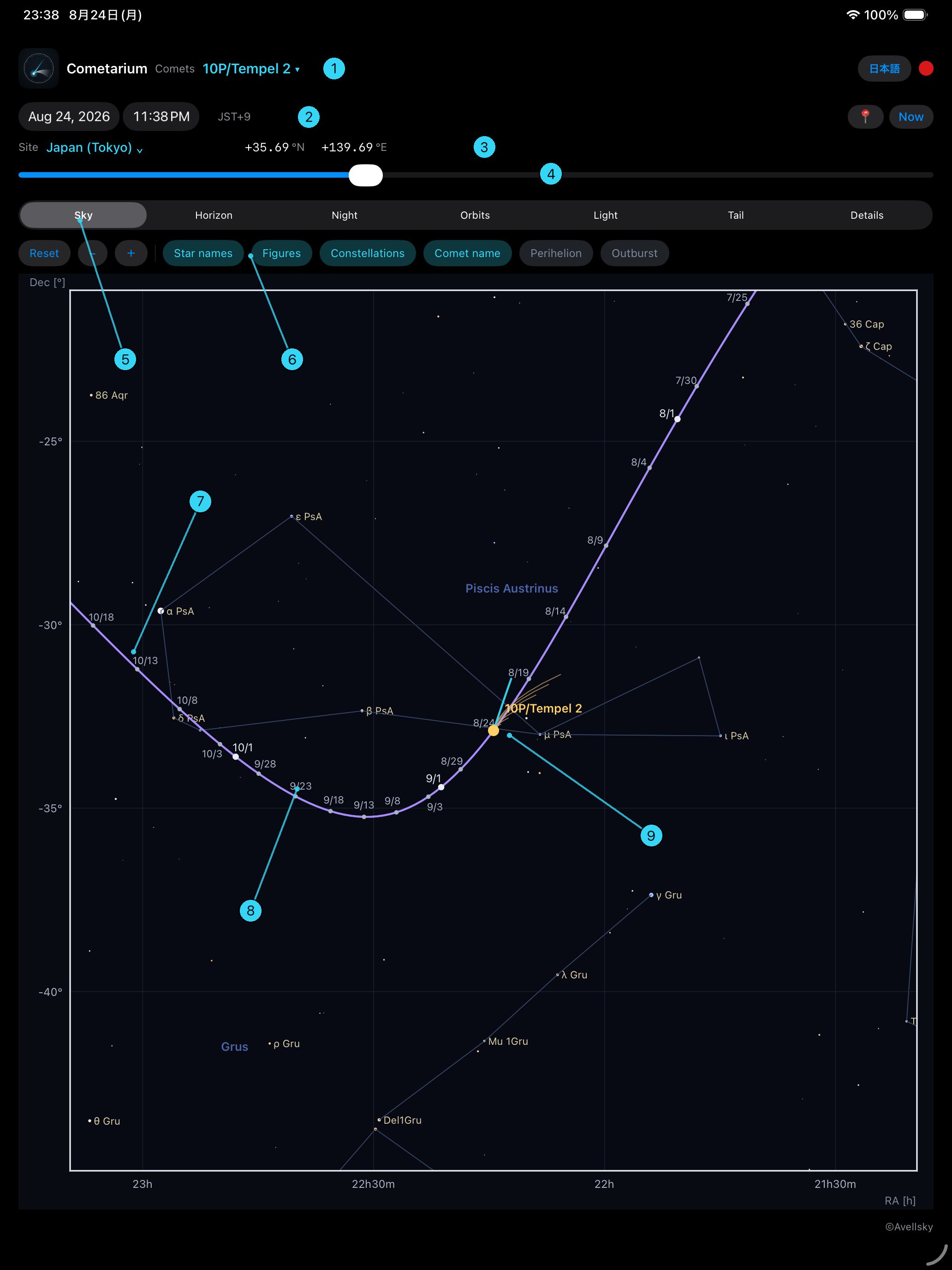
| Name | What it is | |
|---|---|---|
| ① | App name and object | The object on show: 10P/Tempel 2, 220P/McNaught, 169P/NEAT or 3200 Phaethon. At the right, 日本語 switches the language and the red dot turns on night mode |
| ② | Date, time and clock | The date and time — type into them if you like — and the clock they are read in. 📍 fills in where you are; Now returns to today |
| ③ | Observing site | A city, or an observatory from the MPC observatory codes, or coordinates typed in |
| ④ | Date slider | The bundled span, end to end |
| ⑤ | Panels | Sky / Horizon / Night / Orbits / Light / Tail / Details |
| ⑥ | Layers | Reset, zoom − and +, and the layers themselves (lit = shown). Each panel has its own |
| ⑦ | Path across the sky | Where the comet goes over the bundled span |
| ⑧ | Date marks | Dates along the path; they subdivide as you zoom in |
| ⑨ | Where it is now, and its name | The comet at the instant set by ④, with its dust and plasma tails |
The seven panels
| Panel | What it shows |
|---|---|
| Sky | The path among the stars, in J2000 equatorial coordinates. Dates subdivide themselves as you zoom in. |
| Horizon | The comet where you would look for it: sky colour by solar altitude, ground, compass, altitude scale. The sky is drawn to 20° below the horizon. |
| Night | One night of altitudes for comet, Sun and Moon, with rise/transit/set, moon phase and sky brightness. |
| Orbits | The Sun, the eight planets and the comet in three dimensions, from any angle. |
| Light | COBS observations, the fitted light curve with its ±3σ band, and the fit's own numbers. |
| Tail | Syndynes, synchrones and the plasma tail, computed live from β, the emission window, the wind speed and the length you choose. |
| Details | Thirty numbers for the instant on show, from right ascension to the orbital elements. |
Drag to move, pinch to zoom, Reset to start again. On the Mac the arrow keys walk the horizon view.
What is inside
Cometarium follows four objects — 10P/Tempel 2, 220P/McNaught, 169P/NEAT and 3200 Phaethon — across seven panels: Sky, Horizon, Night, Orbits, Light, Tail and Details. Any of the four can be drawn against the others in the solar-system view. Everything is computed on the device; the network is used only by Refit, and there is no account.
Sources
Orbits and ephemerides: NASA/JPL Horizons, SBDB and NAIF SPICE (DE440, sb441). Integration: ASSIST/REBOUND, with planetary and main-belt perturbations and non-gravitational acceleration. Photometry: COBS. Stars: Bright Star Catalogue. Sun, Moon and planets: Meeus, Astronomical Algorithms, and Standish's approximate elements, computed inside the app. Tails: Finson–Probstein syndynes and synchrones, Burns–Lamy–Soter β, and a solar-wind windsock model. Sky brightness: Krisciunas & Schaefer 1991. Credit: NASA/JPL-Caltech; comet magnitude data courtesy of COBS.
プライバシー / Privacy
本アプリはいかなるデータも収集・送信しません。 / The app collects and transmits no data whatsoever. プライバシーポリシー / Privacy Policy