 # Cometarium User Manual (Free Edition 1.1)
Cometarium shows where a comet is, when it can be seen and how its tails lie on
the sky, for iPhone, iPad and Mac. The stars come from a real catalogue, the
comet's position from an N-body integration started at the NASA/JPL orbit
solution, and the tails from radiation-pressure and solar-wind models.
- The free edition covers **10P/Tempel 2**, **220P/McNaught**, **169P/NEAT** and
**3200 Phaethon** (the Geminid parent body)
- Observing sites include the prefectures and, from the **MPC observatory codes**,
142 stations in Japan and 2546 abroad
- The one thing that reaches the network is the light curve's **Refit** button,
which reads the newest COBS observations. No data collection, no advertising
- Requires iOS/iPadOS 17 or later, macOS 14 or later
---
## 1. The bar at the top
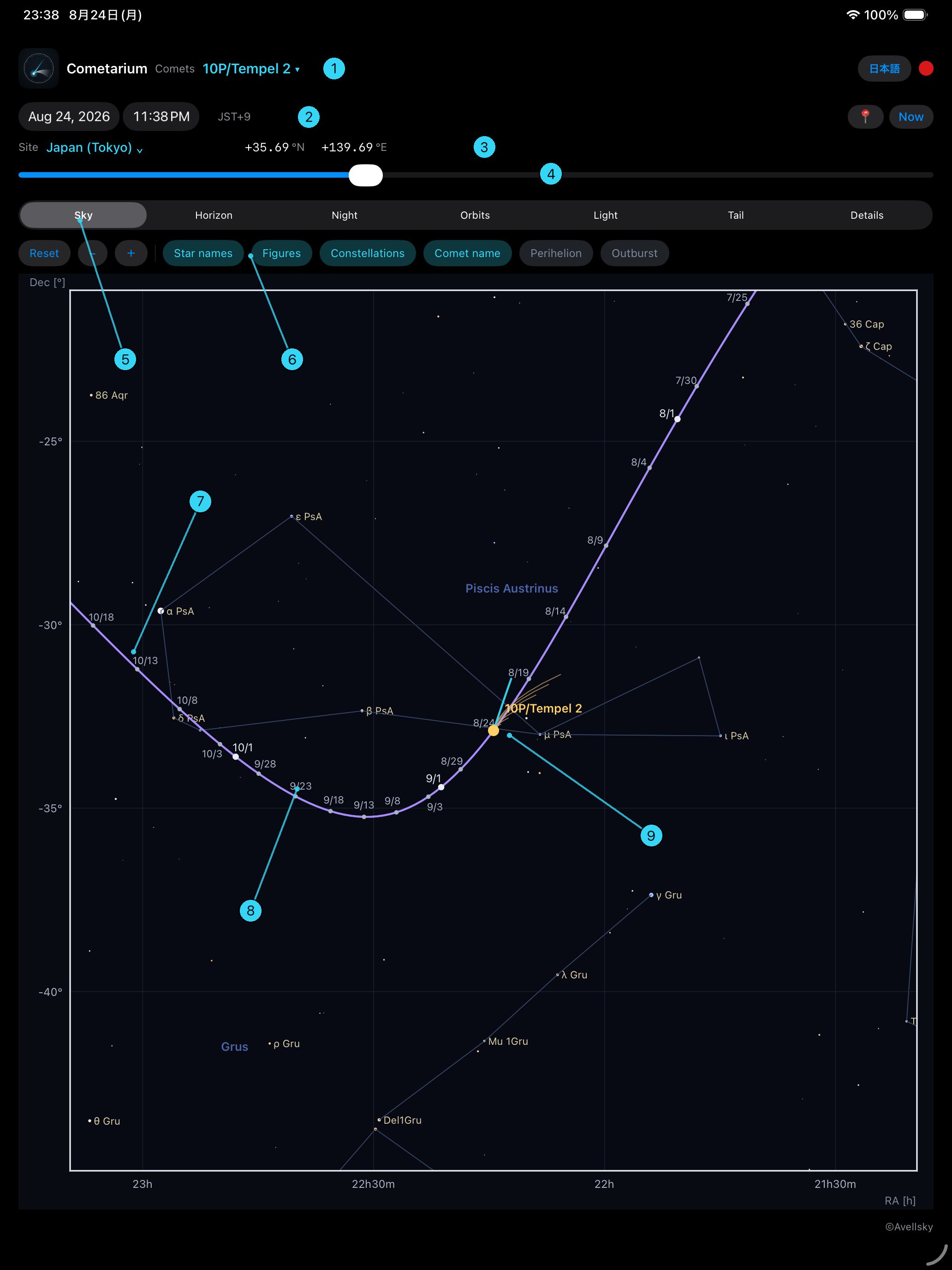
| | Name | What it is |
|---|---|---|
| ① | App name and object | The object on show: 10P/Tempel 2, 220P/McNaught, 169P/NEAT or 3200 Phaethon. At the right, **日本語** switches the language and the **red dot** turns on night mode |
| ② | Date, time and clock | The date and time — type into them if you like — and the clock they are read in. **📍** fills in where you are; **Now** returns to today |
| ③ | Observing site | A city, or an observatory from the MPC observatory codes, or coordinates typed in |
| ④ | Date slider | The bundled span, end to end |
| ⑤ | Panels | Sky / Horizon / Night / Orbits / Light / Tail / Details |
| ⑥ | Layers | Reset, zoom − and +, and the layers themselves (lit = shown). Each panel has its own |
| ⑦ | Path across the sky | Where the comet goes over the bundled span |
| ⑧ | Date marks | Dates along the path; they subdivide as you zoom in |
| ⑨ | Where it is now, and its name | The comet at the instant set by ④, with its dust and plasma tails |
Perihelion and Outburst are switched off in this figure. Turn them on and the
path carries the point where the comet passes closest to the Sun, and any
outburst that was observed, with its date and how much it brightened.
On the horizon and night panels a row of fine steps appears under ④, with
**Transit** in the middle: the moment the comet crosses the meridian that day.
Drag to move, pinch to zoom, Reset to start again. On the Mac the arrow keys
walk the horizon view.
## 2. Sky
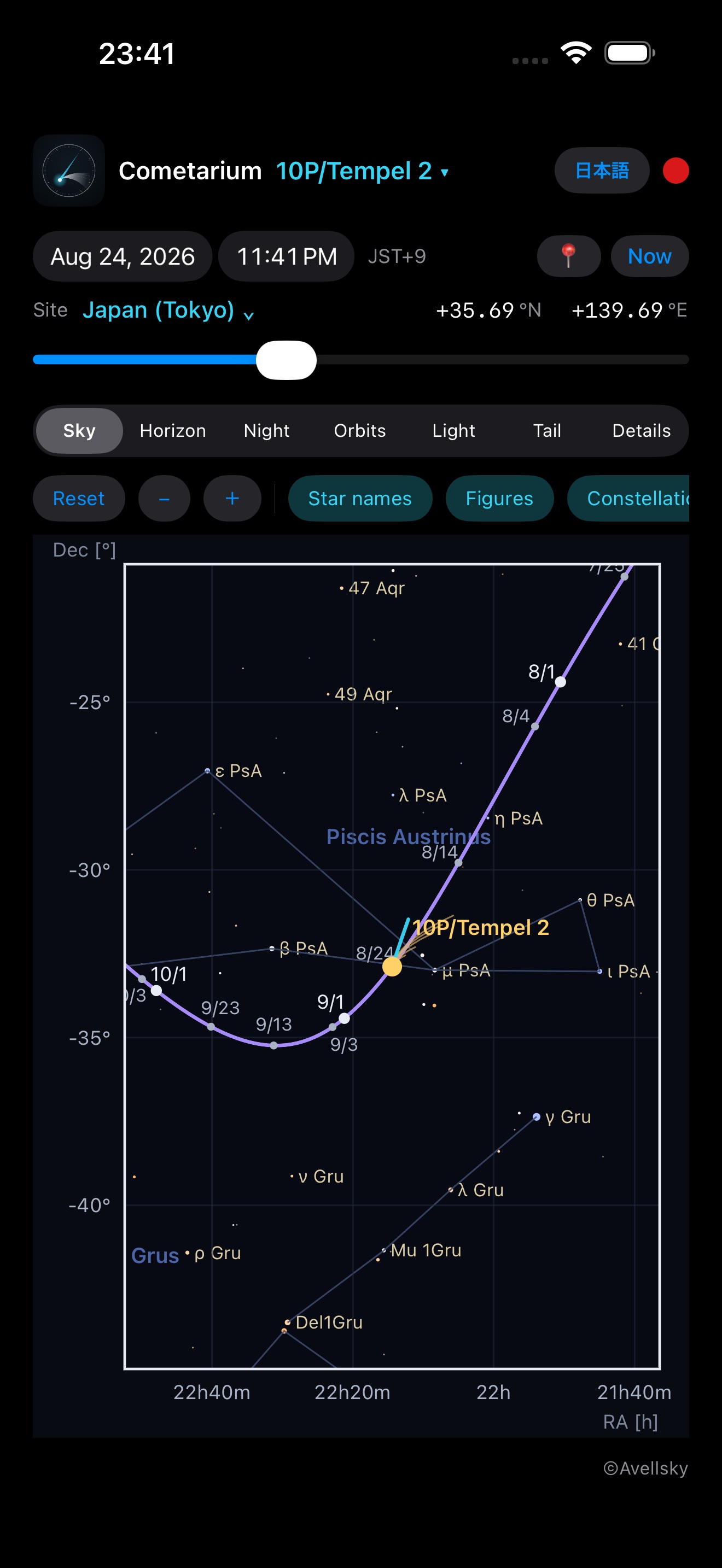
The path among the stars in J2000 equatorial coordinates. Right ascension
increases to the left, as it does facing south. The date ticks subdivide
themselves as you zoom in. Star colour follows the B−V index, size the visual
magnitude. The comet carries the tail set on the Tail panel.
## 3. Horizon
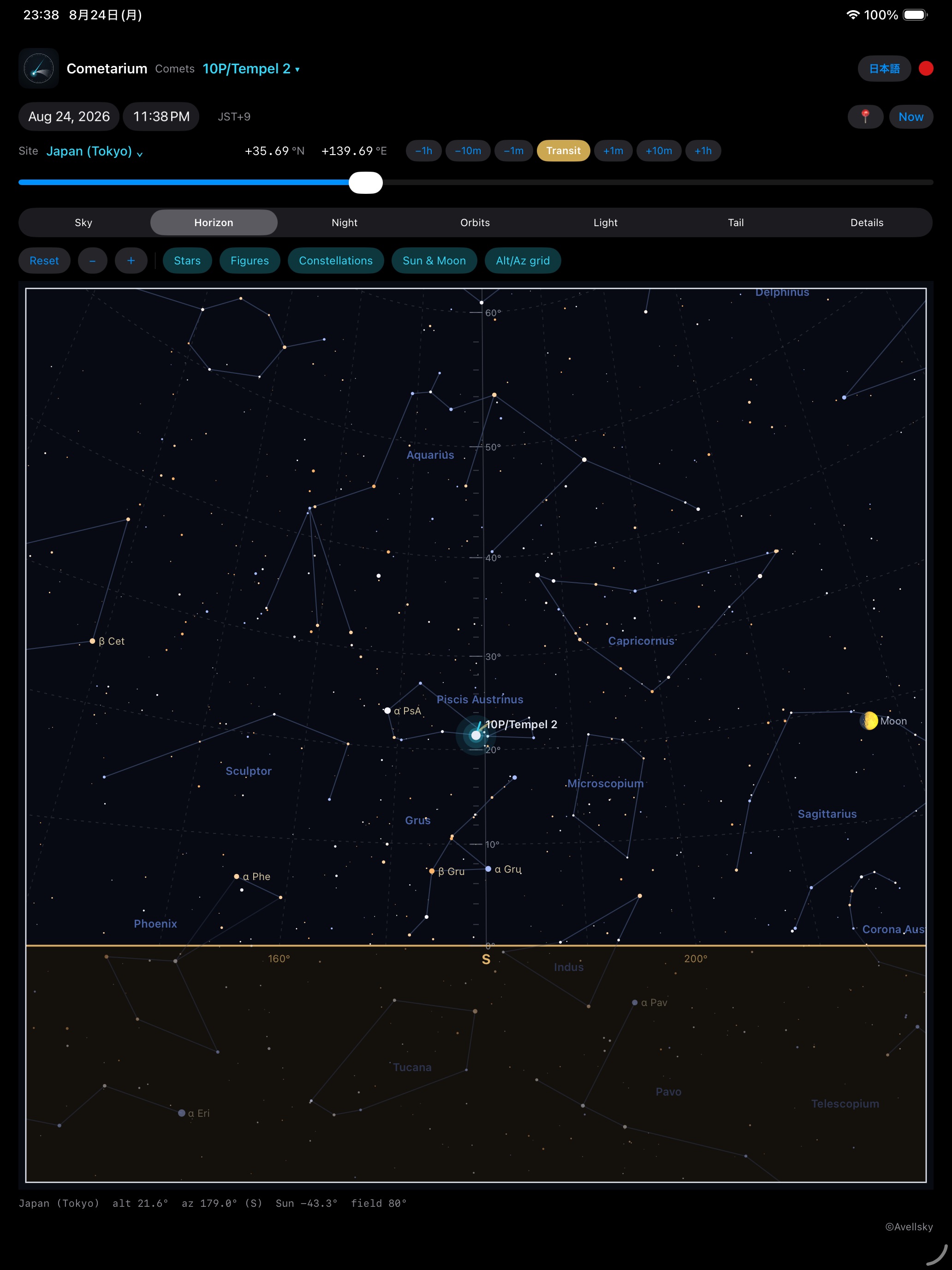
Your own sky, centred on the comet: the sky takes its colour from the Sun's
altitude, with the ground, the compass and an altitude scale. Azimuth increases
to the right. The grid follows the field — 10° steps at a 60° field, 1° at 10° —
and the sky is drawn to 20° below the horizon, so what is about to rise can be
seen waiting. When the comet is under the ground the view stops at the horizon.
## 4. Night
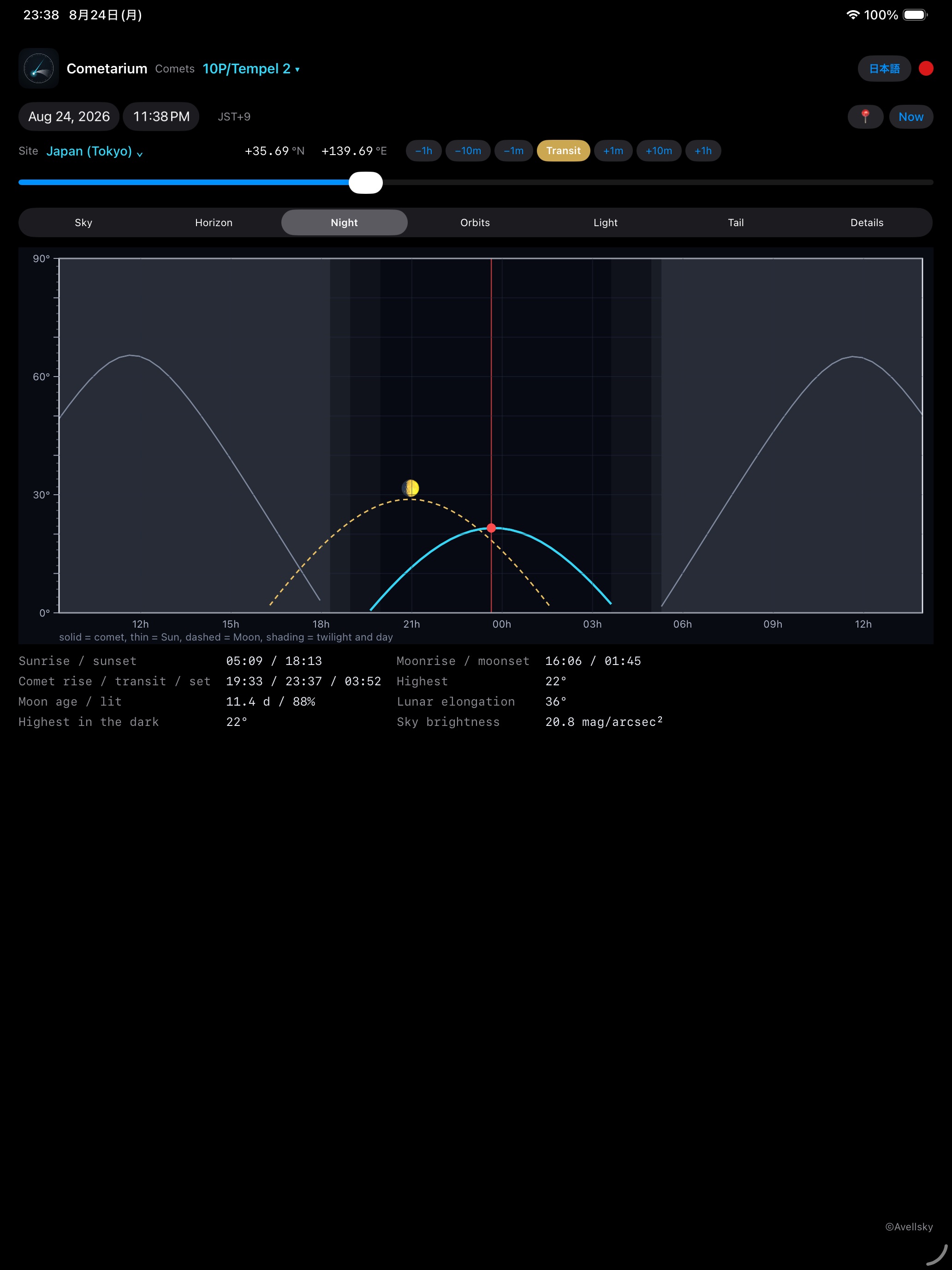
One night of altitudes for the comet, the Sun and the Moon, with rise, transit
and set, the Moon's age and phase, lunar elongation and sky brightness.
## 5. Orbits
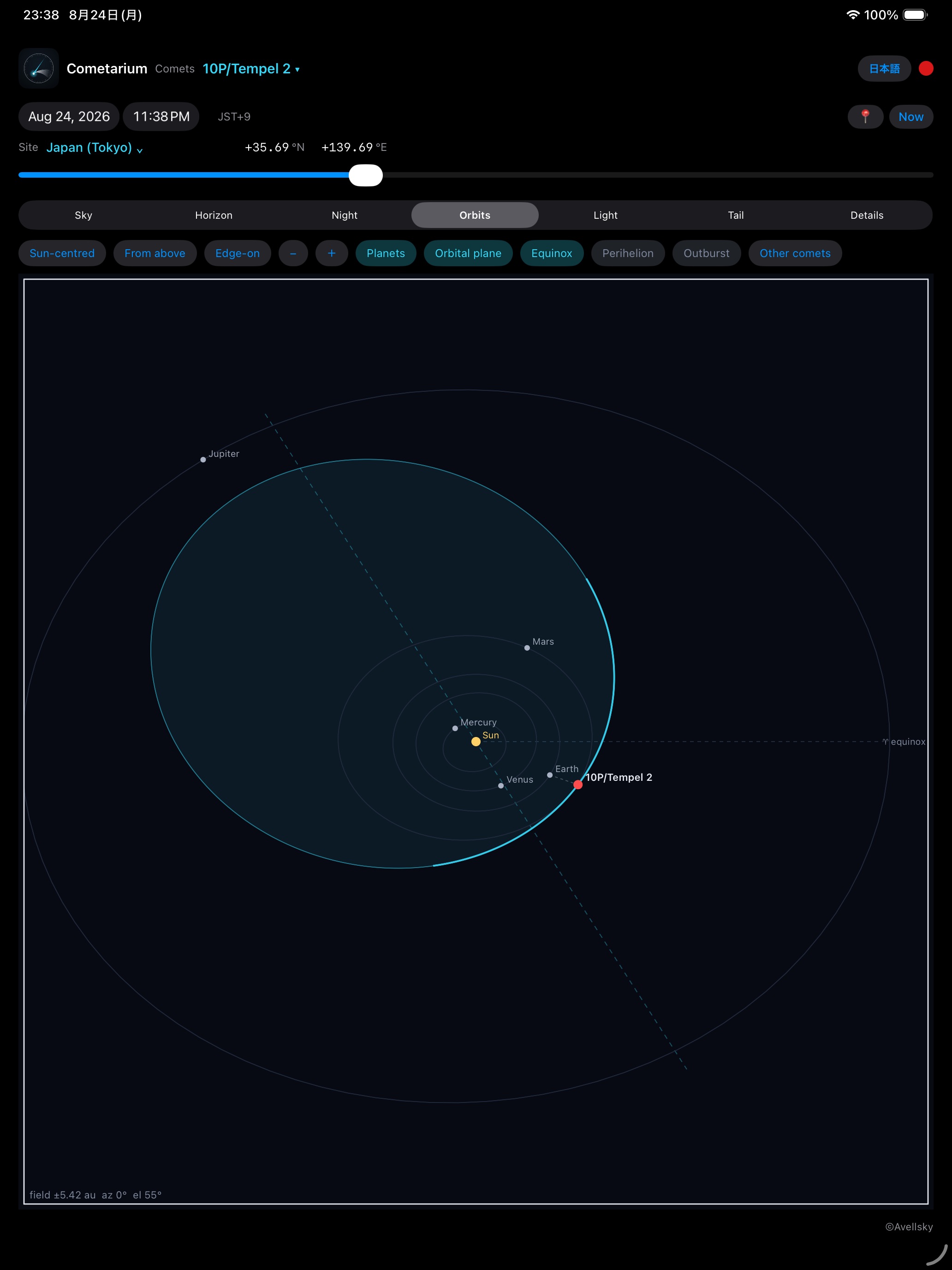
The Sun, the eight planets and the comet in three dimensions. Drag to turn the
view; centre it on the Sun, the Earth or the comet; add other comets alongside
(220P in the free edition).
## 6. Light
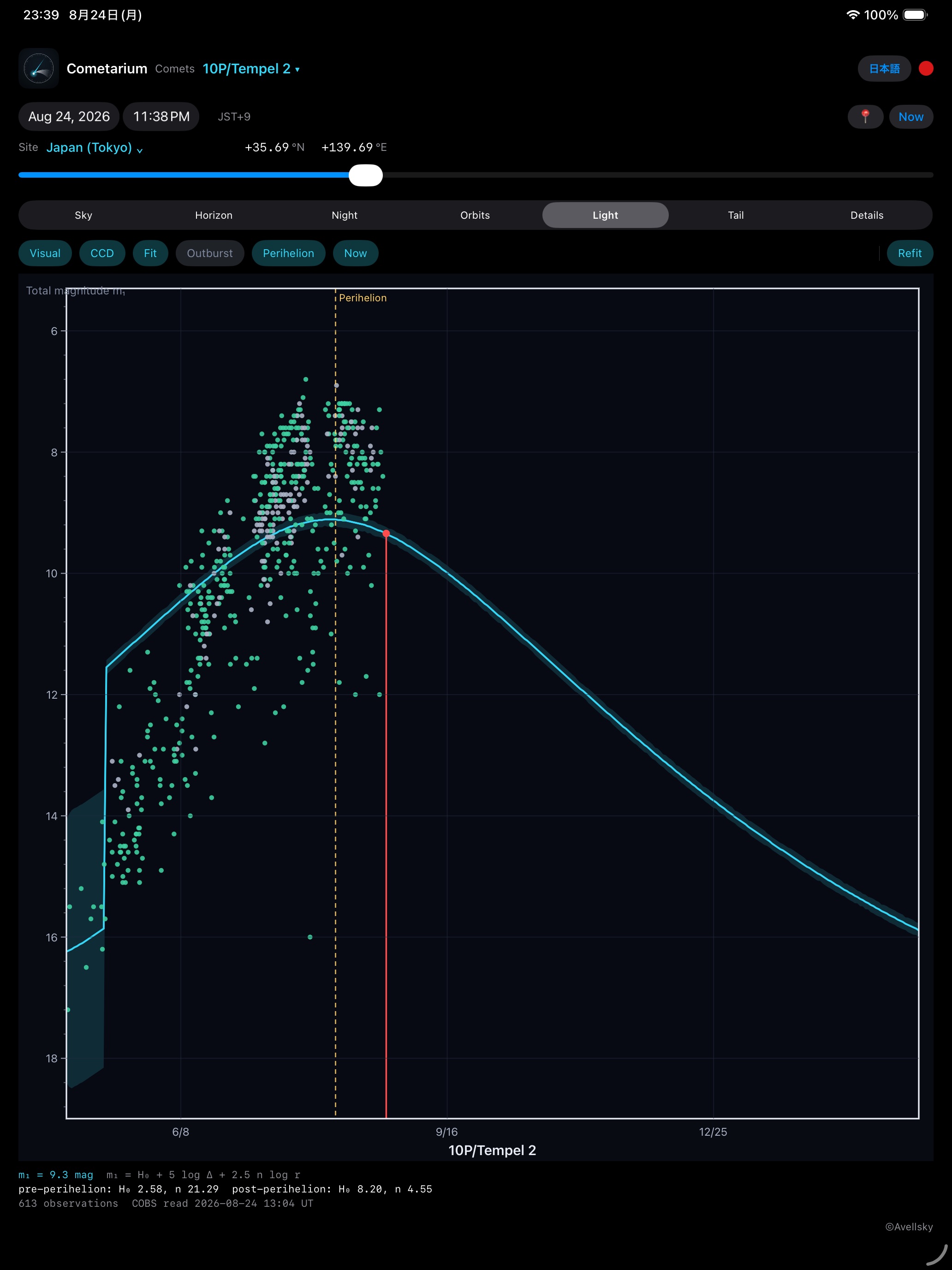
COBS visual and CCD observations under the fitted light curve and its ±3σ band,
with the fit's own numbers: `m₁ = H₀ + 5 log Δ + 2.5 n log r`, H₀ and n either
side of perihelion, the number of observations and when COBS was read.
**Refit** reads the newest COBS observations on the spot and fits H₀ and n again
(a few seconds). While the line under the plot says *refitted on this device* you
are looking at that fit rather than the bundled one; **Undo** puts the bundled one
back. The fit is robust (Huber loss), absorbs each observer's zero point, and
estimates the two sides of perihelion separately.
**3200 Phaethon follows a different law.** SBDB lists it as an asteroid and so
carries no cometary M1/K1; its brightness comes from the asteroid standard, the
IAU (H, G) system: `V = H + 5 log rΔ − 2.5 log Φ(α)`. The phase-angle term is what
the comet law does not have, and it makes the apparent brightness swing sharply
around perihelion. It is an inactive body's light — the brightening from dust
release near perihelion is not in it. COBS holds no observations of it, so no
Refit button is offered.
## 7. Tail
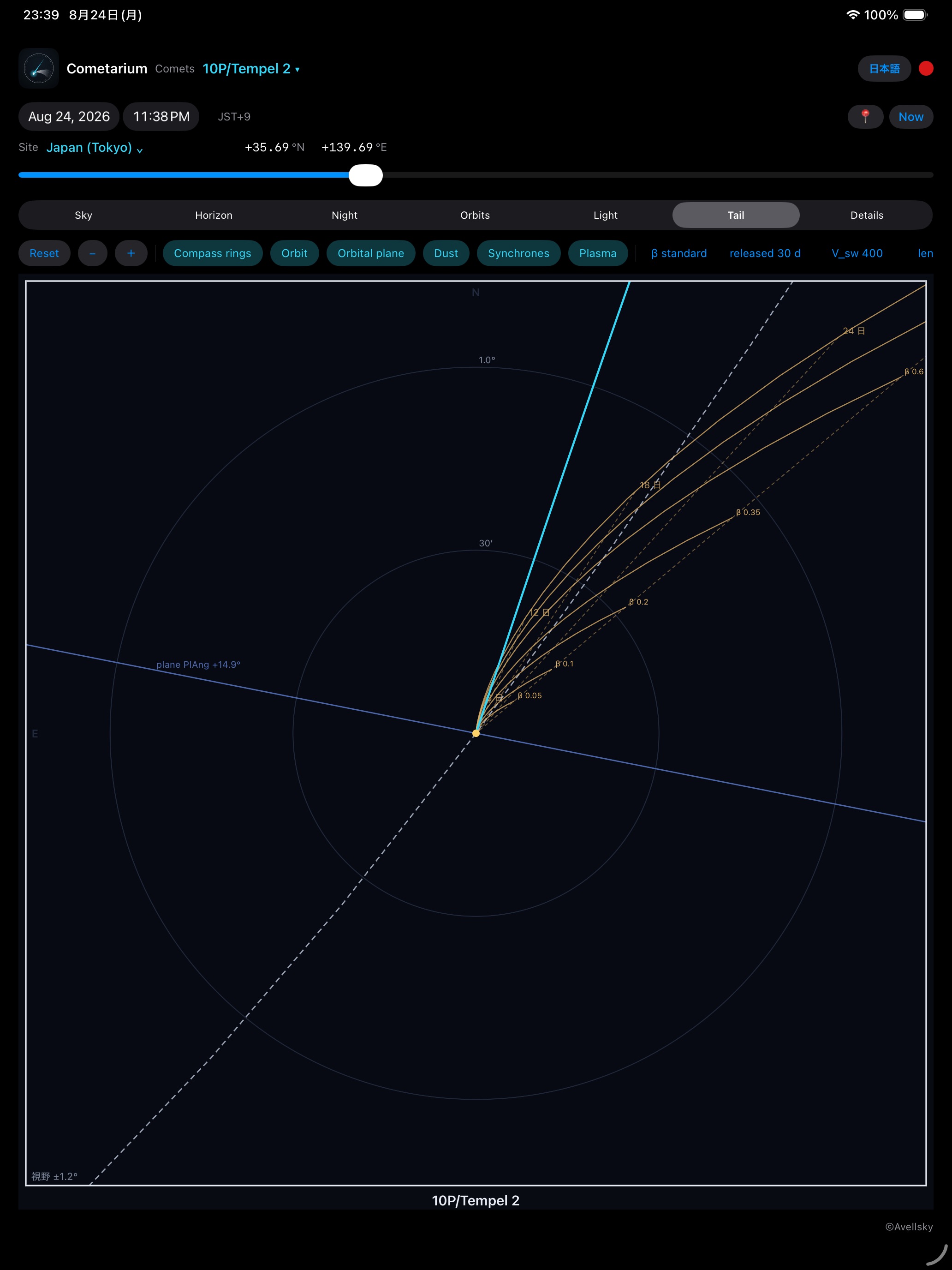
Position angle from the nucleus, north up and east left. Choose the β grid, how
far back emission is followed (3 to 90 days), the solar wind speed and the
length, and the syndynes, synchrones and plasma tail are computed on the spot —
and drawn on the sky and horizon panels too.
## 8. Details
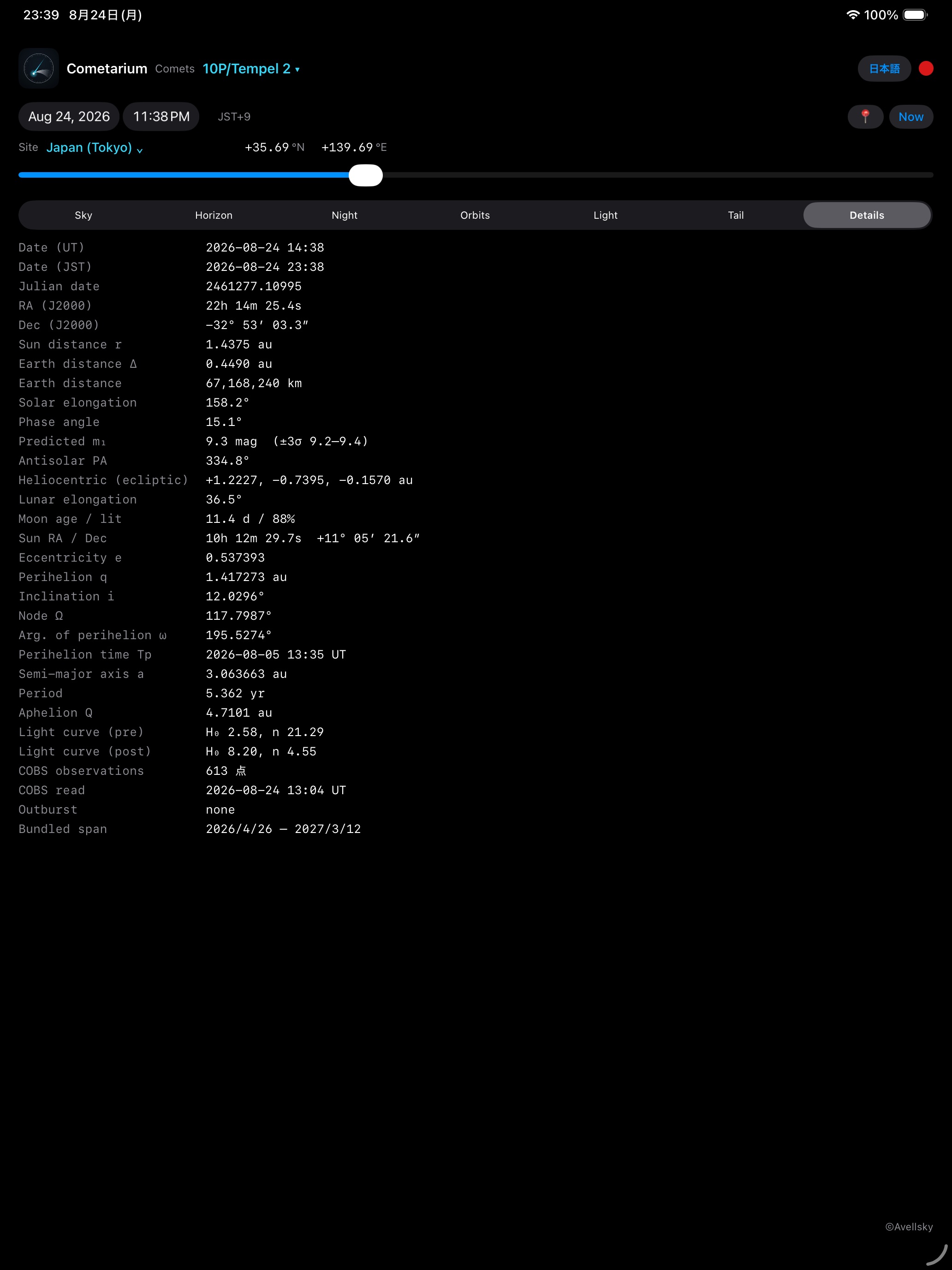
Thirty numbers for the instant on show, corrected for light time.
For a body registered as an asteroid (3200 Phaethon) the **Photometry model** row
reads *asteroid standard (IAU H, G)* and is followed by the law, H, G and the phase
function Φ(α) at that instant, with a note that the comet law is not used.
## 9. On iPhone
## 10. What is inside
| Item | What |
|---|---|
| Objects | 10P/Tempel 2, 220P/McNaught, 169P/NEAT, 3200 Phaethon |
| Panels | Sky, Horizon, Night, Orbits, Light, Tail, Details |
| Comparison orbits in Orbits | any of the four, against each other |
| Observing sites | prefectures + MPC observatory codes (142 in Japan / 2546 abroad) |
| Computation | on the device; the network is used only by Refit |
## 11. Sources
Orbits and ephemerides: NASA/JPL Horizons, SBDB, NAIF SPICE (DE440, sb441).
Integration: ASSIST/REBOUND with planetary and main-belt perturbations and
non-gravitational acceleration. Photometry: COBS. Stars: Bright Star Catalogue;
constellation figures from d3-celestial. Sun, Moon and planets: Meeus,
*Astronomical Algorithms*, and Standish's approximate elements. Tails:
Finson–Probstein, Burns–Lamy–Soter β, solar-wind windsock. Sky brightness:
Krisciunas & Schaefer 1991.
Credit: NASA/JPL-Caltech.
Comet magnitude data courtesy of COBS Comet Observation Database —
---
Contact: avellsky@gmail.com
© Cometarium, Avellsky
# Cometarium User Manual (Free Edition 1.1)
Cometarium shows where a comet is, when it can be seen and how its tails lie on
the sky, for iPhone, iPad and Mac. The stars come from a real catalogue, the
comet's position from an N-body integration started at the NASA/JPL orbit
solution, and the tails from radiation-pressure and solar-wind models.
- The free edition covers **10P/Tempel 2**, **220P/McNaught**, **169P/NEAT** and
**3200 Phaethon** (the Geminid parent body)
- Observing sites include the prefectures and, from the **MPC observatory codes**,
142 stations in Japan and 2546 abroad
- The one thing that reaches the network is the light curve's **Refit** button,
which reads the newest COBS observations. No data collection, no advertising
- Requires iOS/iPadOS 17 or later, macOS 14 or later

---
## 1. The bar at the top

| | Name | What it is |
|---|---|---|
| ① | App name and object | The object on show: 10P/Tempel 2, 220P/McNaught, 169P/NEAT or 3200 Phaethon. At the right, **日本語** switches the language and the **red dot** turns on night mode |
| ② | Date, time and clock | The date and time — type into them if you like — and the clock they are read in. **📍** fills in where you are; **Now** returns to today |
| ③ | Observing site | A city, or an observatory from the MPC observatory codes, or coordinates typed in |
| ④ | Date slider | The bundled span, end to end |
| ⑤ | Panels | Sky / Horizon / Night / Orbits / Light / Tail / Details |
| ⑥ | Layers | Reset, zoom − and +, and the layers themselves (lit = shown). Each panel has its own |
| ⑦ | Path across the sky | Where the comet goes over the bundled span |
| ⑧ | Date marks | Dates along the path; they subdivide as you zoom in |
| ⑨ | Where it is now, and its name | The comet at the instant set by ④, with its dust and plasma tails |
Perihelion and Outburst are switched off in this figure. Turn them on and the
path carries the point where the comet passes closest to the Sun, and any
outburst that was observed, with its date and how much it brightened.
On the horizon and night panels a row of fine steps appears under ④, with
**Transit** in the middle: the moment the comet crosses the meridian that day.
Drag to move, pinch to zoom, Reset to start again. On the Mac the arrow keys
walk the horizon view.
## 2. Sky
The path among the stars in J2000 equatorial coordinates. Right ascension
increases to the left, as it does facing south. The date ticks subdivide
themselves as you zoom in. Star colour follows the B−V index, size the visual
magnitude. The comet carries the tail set on the Tail panel.
## 3. Horizon

Your own sky, centred on the comet: the sky takes its colour from the Sun's
altitude, with the ground, the compass and an altitude scale. Azimuth increases
to the right. The grid follows the field — 10° steps at a 60° field, 1° at 10° —
and the sky is drawn to 20° below the horizon, so what is about to rise can be
seen waiting. When the comet is under the ground the view stops at the horizon.
## 4. Night

One night of altitudes for the comet, the Sun and the Moon, with rise, transit
and set, the Moon's age and phase, lunar elongation and sky brightness.
## 5. Orbits

The Sun, the eight planets and the comet in three dimensions. Drag to turn the
view; centre it on the Sun, the Earth or the comet; add other comets alongside
(220P in the free edition).
## 6. Light

COBS visual and CCD observations under the fitted light curve and its ±3σ band,
with the fit's own numbers: `m₁ = H₀ + 5 log Δ + 2.5 n log r`, H₀ and n either
side of perihelion, the number of observations and when COBS was read.
**Refit** reads the newest COBS observations on the spot and fits H₀ and n again
(a few seconds). While the line under the plot says *refitted on this device* you
are looking at that fit rather than the bundled one; **Undo** puts the bundled one
back. The fit is robust (Huber loss), absorbs each observer's zero point, and
estimates the two sides of perihelion separately.
**3200 Phaethon follows a different law.** SBDB lists it as an asteroid and so
carries no cometary M1/K1; its brightness comes from the asteroid standard, the
IAU (H, G) system: `V = H + 5 log rΔ − 2.5 log Φ(α)`. The phase-angle term is what
the comet law does not have, and it makes the apparent brightness swing sharply
around perihelion. It is an inactive body's light — the brightening from dust
release near perihelion is not in it. COBS holds no observations of it, so no
Refit button is offered.
## 7. Tail

Position angle from the nucleus, north up and east left. Choose the β grid, how
far back emission is followed (3 to 90 days), the solar wind speed and the
length, and the syndynes, synchrones and plasma tail are computed on the spot —
and drawn on the sky and horizon panels too.
## 8. Details

Thirty numbers for the instant on show, corrected for light time.
For a body registered as an asteroid (3200 Phaethon) the **Photometry model** row
reads *asteroid standard (IAU H, G)* and is followed by the law, H, G and the phase
function Φ(α) at that instant, with a note that the comet law is not used.
## 9. On iPhone

## 10. What is inside
| Item | What |
|---|---|
| Objects | 10P/Tempel 2, 220P/McNaught, 169P/NEAT, 3200 Phaethon |
| Panels | Sky, Horizon, Night, Orbits, Light, Tail, Details |
| Comparison orbits in Orbits | any of the four, against each other |
| Observing sites | prefectures + MPC observatory codes (142 in Japan / 2546 abroad) |
| Computation | on the device; the network is used only by Refit |
## 11. Sources
Orbits and ephemerides: NASA/JPL Horizons, SBDB, NAIF SPICE (DE440, sb441).
Integration: ASSIST/REBOUND with planetary and main-belt perturbations and
non-gravitational acceleration. Photometry: COBS. Stars: Bright Star Catalogue;
constellation figures from d3-celestial. Sun, Moon and planets: Meeus,
*Astronomical Algorithms*, and Standish's approximate elements. Tails:
Finson–Probstein, Burns–Lamy–Soter β, solar-wind windsock. Sky brightness:
Krisciunas & Schaefer 1991.
Credit: NASA/JPL-Caltech.
Comet magnitude data courtesy of COBS Comet Observation Database —
---
Contact: avellsky@gmail.com
© Cometarium, Avellsky